
Yak for Kids | Facts, Habitat, Adaptations & Life Cycle
Imagine standing on a cold mountain plateau, surrounded by snow-covered peaks and strong winds. In the distance, a large, shaggy animal with curved horns grazes on short mountain grasses. Meet the yak, an extraordinary mammal adapted to life in some of the highest and coldest landscapes in Asia!
Yaks are famous for their long, woolly coats, strong bodies, and remarkable ability to survive at high elevations. In this Yak Animal Guide for Kids, discover interesting yak facts, where yaks live, what they eat, how they survive in thin mountain air, the differences between wild and domestic yaks, and the stages of the yak life cycle.
Teachers, parents, and homeschool families can also explore printable yak research worksheets, Montessori life cycle cards, reading comprehension activities, crafts, and animal puzzles.
🐂 Yak at a Glance
Yaks are large, hoofed mammals belonging to the cattle family, Bovidae. They are closely related to domestic cattle and other wild bovines.
- Common Name: Yak
- Scientific Name: Bos grunniens (domestic yak); Bos mutus (wild yak)
- Animal Group: Mammal
- Family: Bovidae
- Habitat: High-altitude grasslands, alpine meadows, and mountain plateaus
- Distribution: Central and High Asia, especially the Tibetan Plateau and surrounding mountain regions
- Diet: Herbivore
- Main Food: Grasses, sedges, and other alpine vegetation
- Baby Name: Calf
- Life Cycle: Developing Calf → Newborn Calf → Growing Calf → Juvenile → Adult
- Special Features: Thick woolly coat, broad hooves, large lungs, strong body, and adaptations to low-oxygen environments
Students can organize their discoveries using our Yak Animal Research Graphic Organizers and Fact Sheet.
🏔️ Where Do Yaks Live?
Yaks are closely associated with the high mountain landscapes and plateaus of Asia.
Wild yaks inhabit remote high-altitude areas of the Tibetan Plateau and surrounding regions. Domestic yaks are raised by communities across parts of the Himalayas, Tibet, Nepal, Bhutan, Mongolia, and nearby areas.
These environments can be extremely challenging. Temperatures may fall far below freezing, strong winds sweep across exposed slopes, and the air contains less oxygen than at sea level.
Many yaks live at elevations of approximately 3,000–5,500 meters (9,800–18,000 feet), although their exact elevation ranges vary.
Mountain grasslands provide the vegetation yaks need for grazing. Seasonal changes affect where they find food and water.
❄️ How Do Yaks Survive Cold Weather?
One of the most fascinating yak facts for kids is that yaks are specially adapted to survive cold mountain environments.
Their long, shaggy outer hair helps protect them from wind, snow, and cold weather.
Beneath this outer coat, yaks have a dense, soft undercoat that provides additional insulation.
Their relatively compact bodies and thick coats help reduce heat loss.
Yaks are well suited to cold climates, but they can struggle in hot weather because their bodies are adapted for low temperatures.
These adaptations make yaks excellent examples of how mammals develop physical characteristics suited to their habitats.
💨 How Do Yaks Breathe at High Altitudes?
Mountain air contains less available oxygen than air at lower elevations because atmospheric pressure decreases with altitude.
Yaks have several adaptations that help them function in these challenging conditions.
- Large Respiratory Capacity: Their respiratory system supports oxygen intake in thin mountain air.
- Efficient Oxygen Transport: Their blood and circulatory system are adapted to deliver oxygen to body tissues.
- Specialized Physiology: Yaks have inherited adaptations that support life at high elevations.
- Cold-Climate Adaptations: Their insulating coats help conserve energy in freezing conditions.
These characteristics allow yaks to graze, walk, and survive in environments that can be difficult for animals adapted to low elevations.
🌿 What Do Yaks Eat?
Yaks are herbivores, meaning they eat plants.
Their diet consists mainly of vegetation growing in mountain grasslands and alpine meadows.
Common foods include:
- Grasses: An important source of food during the growing season.
- Sedges: Grass-like plants found in many alpine environments.
- Herbs: Small flowering and non-woody plants.
- Other Alpine Vegetation: Available plants that vary with season and habitat.
Yaks are ruminants, meaning they have a specialized digestive system that helps them break down fibrous plant material.
They chew partially digested food again in a process called rumination, or chewing cud.
This helps them obtain nutrients from tough grasses and other vegetation.
🐄 Yak vs. Cow: What's the Difference?
Yaks and domestic cattle are closely related bovines, but they have different adaptations.
- Yaks: Typically have long shaggy coats, strong cold tolerance, and adaptations for high-altitude environments.
- Domestic Cattle: Have been bred into many varieties adapted to different climates and farming systems.
Both animals are hoofed, herbivorous mammals that chew cud and nurse their calves with milk.
Yaks are particularly valuable in high mountain regions where many common cattle breeds may struggle with the cold and reduced oxygen availability.
🐂 Wild Yak vs. Domestic Yak
There are important differences between wild and domestic yaks.
Wild Yaks
- Live in remote mountain and plateau habitats.
- Are generally larger and heavier than domestic yaks.
- Have dark, shaggy coats and powerful bodies.
- Form social groups and graze on natural vegetation.
- Face conservation threats including habitat disturbance and competition for resources.
Domestic Yaks
- Are raised by people in high-altitude communities.
- Can have different coat colors, including black, brown, white, and mixed patterns.
- Provide milk, fiber, meat, and transportation in some regions.
- Are often smaller than their wild relatives.
- Play important economic and cultural roles in mountain communities.
Domestic and wild yaks share many physical characteristics but differ in their relationships with humans and their living conditions.
🏘️ Why Are Yaks Important to Mountain Communities?
Domestic yaks have supported people living in high-altitude regions for many generations.
In some Himalayan and Tibetan communities, yaks provide valuable resources and services.
- Milk: Used to make dairy products such as butter, cheese, and yogurt.
- Fiber: Soft undercoat fibers can be used for textiles and clothing.
- Transportation: Yaks can carry supplies across difficult mountain terrain.
- Meat: Provides food in some communities.
- Dung: Can be dried and used as fuel where firewood is scarce.
The importance of yaks varies among communities, but they remain closely connected to the livelihoods and traditions of many highland populations.
👨👩👧👦 Do Yaks Live in Herds?
Yaks are social animals that often gather in groups called herds.
Wild female yaks and their young may form groups, while adult males are sometimes solitary or gather in smaller male groups outside the breeding season.
Domestic yaks may also live in managed herds.
Herd living can help animals maintain social relationships and respond to their surroundings.
Group sizes and social behaviors vary depending on age, sex, season, and environmental conditions.
🐾 What Animals Hunt Yaks?
Adult wild yaks are large and powerful animals, but young or vulnerable individuals can face predators.
Wolves are among the predators known to hunt yaks, particularly calves or weakened animals.
In some regions, other large carnivores may occasionally threaten young livestock.
Yaks have strong bodies, sharp horns, and powerful hooves that can help them defend themselves.
Living in groups may also help young animals remain near protective adults.
👶 Yak Life Cycle
The yak life cycle begins before birth, when a developing calf grows inside its mother's body.
- Developing Calf: The unborn yak grows inside its mother during pregnancy.
- Newborn Calf: A baby yak is born and begins learning to stand and walk.
- Growing Calf: The calf drinks its mother's milk and gradually begins eating grasses and other vegetation.
- Juvenile Yak: The young yak becomes more independent while continuing to grow and develop.
- Adult Yak: A mature yak can reproduce and continue the life cycle.
Yak pregnancy generally lasts approximately 8–9 months.
Female yaks usually give birth to one calf at a time.
Newborn calves depend on their mothers for milk, warmth, and protection.
As they grow, calves begin grazing and develop the strength and skills needed to survive in mountain environments.
Explore these stages with our Yak Life Cycle Poster and Cut-and-Paste Worksheet or Yak Life Cycle Montessori 3-Part Cards.
🔍 Parts of a Yak
Yaks have specialized body structures that help them survive in cold, high-altitude environments.
- Head: Contains the eyes, ears, nostrils, and mouth.
- Horns: Used in defense and interactions with other yaks.
- Ears: Help detect sounds in the surrounding environment.
- Eyes: Help detect movement and navigate their surroundings.
- Muzzle: Contains the mouth and nostrils used for feeding and breathing.
- Thick Coat: Provides insulation against cold weather.
- Undercoat: Soft, dense fibers that help retain warmth.
- Legs: Strong limbs adapted for walking across mountain terrain.
- Hooves: Provide support and traction on uneven ground.
- Tail: Covered with long hair and used for swatting insects.
🌎 Why Are Yaks Important to Mountain Ecosystems?
Wild yaks are important large herbivores in high-altitude ecosystems.
Through grazing, they influence plant communities and the structure of alpine grasslands.
Their movements and waste also contribute to nutrient cycling.
Yaks interact with other mountain animals through competition, grazing, and predator-prey relationships.
Studying wild yaks helps scientists understand how large mammals survive in extreme mountain environments.
⚠️ What Threatens Wild Yaks?
Wild yaks face several conservation challenges.
- Habitat Disturbance: Human activity can disrupt remote mountain habitats.
- Competition for Grazing: Domestic livestock may compete with wild yaks for vegetation.
- Hunting: Historical and illegal hunting have affected wild yak populations.
- Hybridization: Interbreeding with domestic yaks can affect wild populations.
- Climate Change: Changes in mountain ecosystems may alter vegetation and habitat conditions.
Conservation efforts focus on protecting wild yak habitats, reducing harmful disturbances, and monitoring populations.
💡 Interesting Yak Facts for Kids
- Yaks are large mammals belonging to the cattle family.
- They are native to high mountain regions of Asia.
- Yaks are especially associated with the Tibetan Plateau.
- Their thick coats help protect them from freezing temperatures.
- Yaks have adaptations that help them survive in thin mountain air.
- They are herbivores that mainly eat grasses and other plants.
- Yaks are ruminants that chew cud.
- Wild yaks are generally larger than domestic yaks.
- Domestic yaks provide milk, fiber, and transportation in some mountain communities.
- Yaks have strong hooves suited to uneven terrain.
- A baby yak is called a calf.
- Yak calves drink milk from their mothers.
✏️ Yak Activities for Kids
Yak activities are perfect for exploring Asian mountain animals, Himalayan habitats, high-altitude adaptations, herbivores, mammal life cycles, animal research, and mountain ecosystems.
Students can compare yaks with domestic cattle, investigate how thick fur provides insulation, or practice nonfiction reading using our Yak Reading Passage and Comprehension Worksheets.
For creative learning, children can enjoy our Yak Cut-and-Paste Craft and Coloring Worksheets, combining mountain animal studies with art and fine-motor practice.
Younger learners can also develop visual matching and problem-solving skills with our Yak Cut-and-Match Animal Puzzle Worksheets.
For a more comprehensive lesson, the Yak Life Cycle 3-in-1 Bundle combines complementary research and life cycle learning resources.
🌸 Explore Our Yak Learning Resources
Discover seven printable yak educational resources from Wuffyland for elementary science lessons, Asian mountain animal studies, Montessori-inspired learning, and homeschool activities.
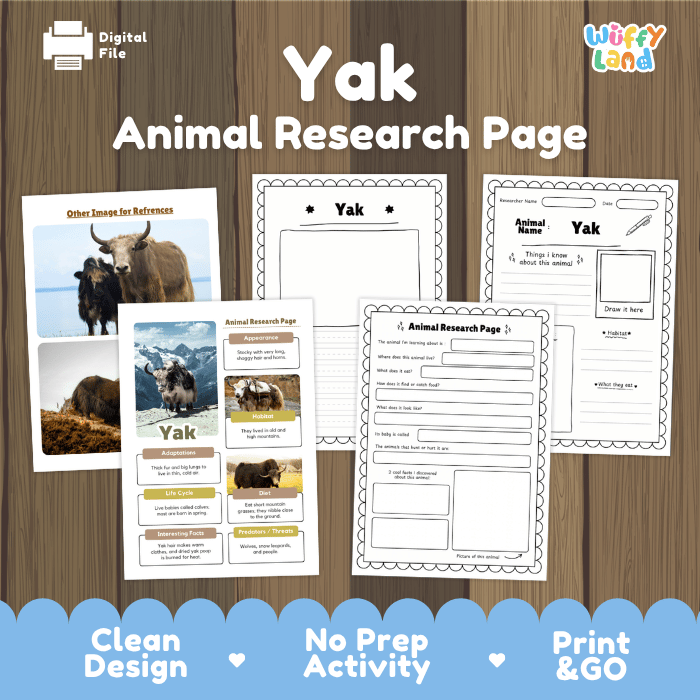
Yak Animal Research Graphic Organizers & Fact Sheet →
Explore yak habitats, diet, adaptations, and scientific facts with printable research organizers and fact sheets.
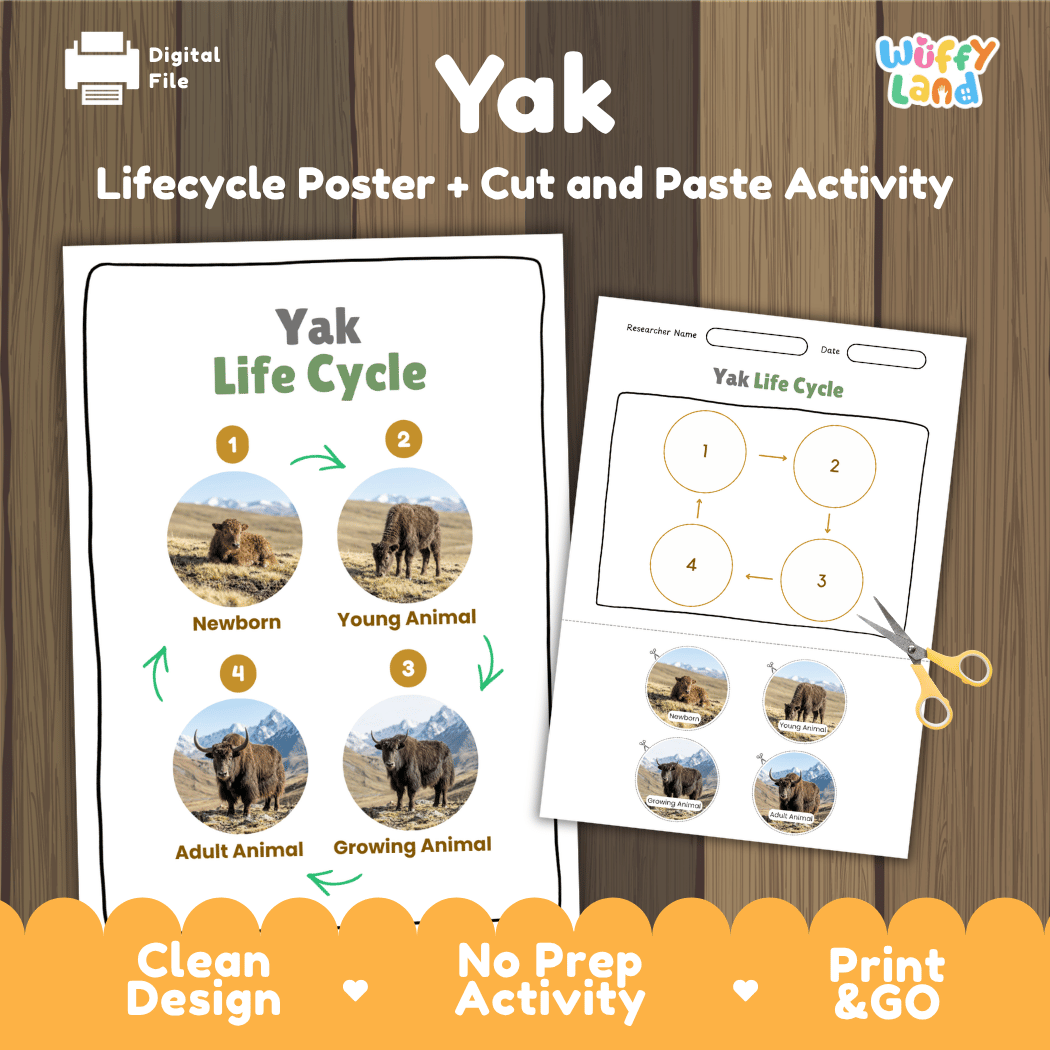
Yak Life Cycle Poster & Cut-and-Paste Worksheet →
Explore yak development from calf to adult with visual life cycle and sequencing activities.

Yak Life Cycle Montessori 3-Part Cards →
Practice yak life cycle vocabulary, matching, and sequencing with Montessori-inspired mammal flashcards.
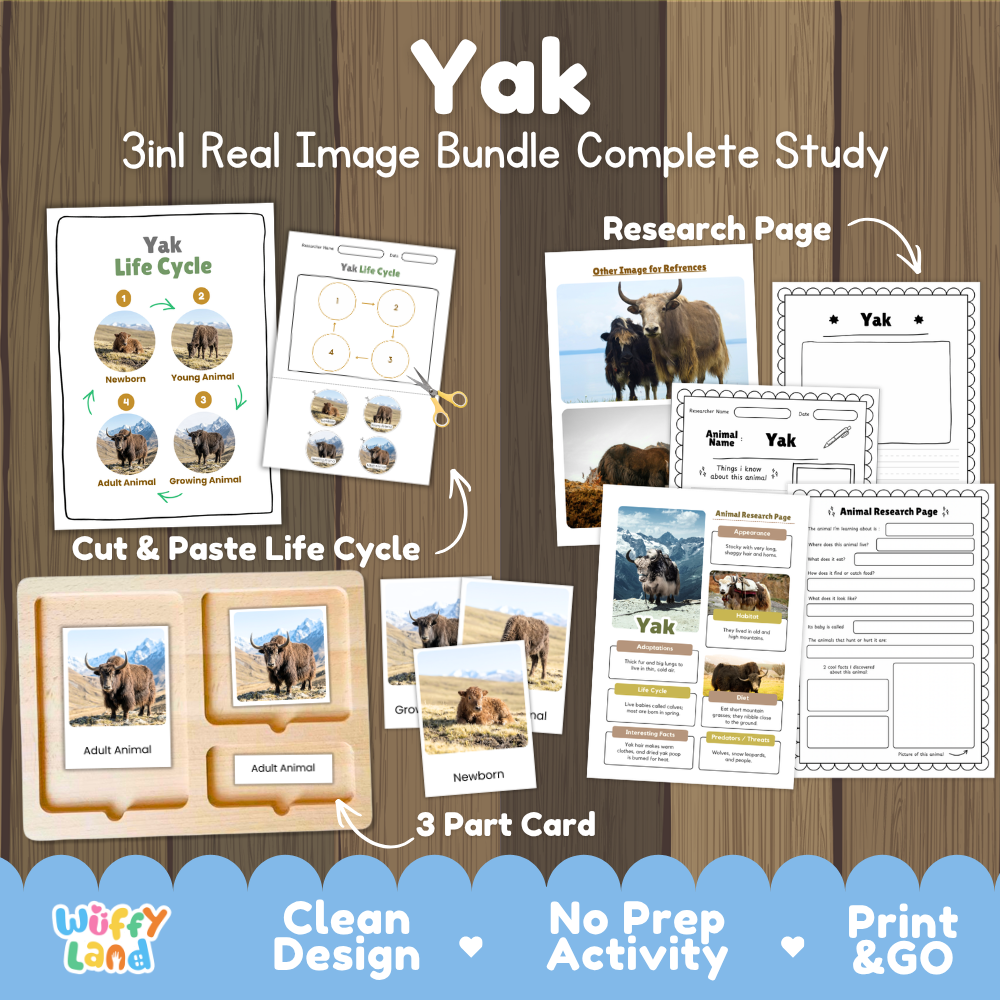
Yak Life Cycle 3-in-1 Bundle →
Combine yak research, real-image learning resources, and Montessori life cycle cards in one bundle.
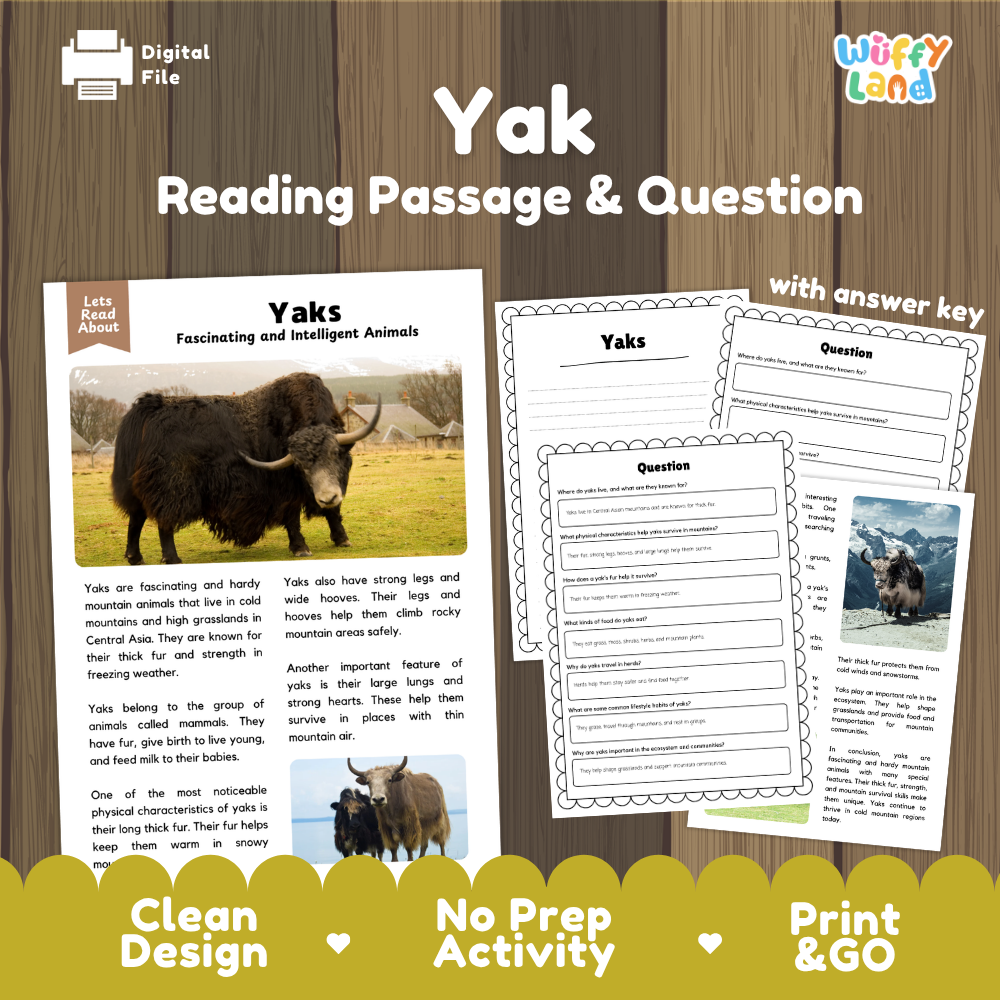
Yak Reading Passage & Comprehension Worksheets →
Build nonfiction reading skills with an informational passage, comprehension questions, and answer key.
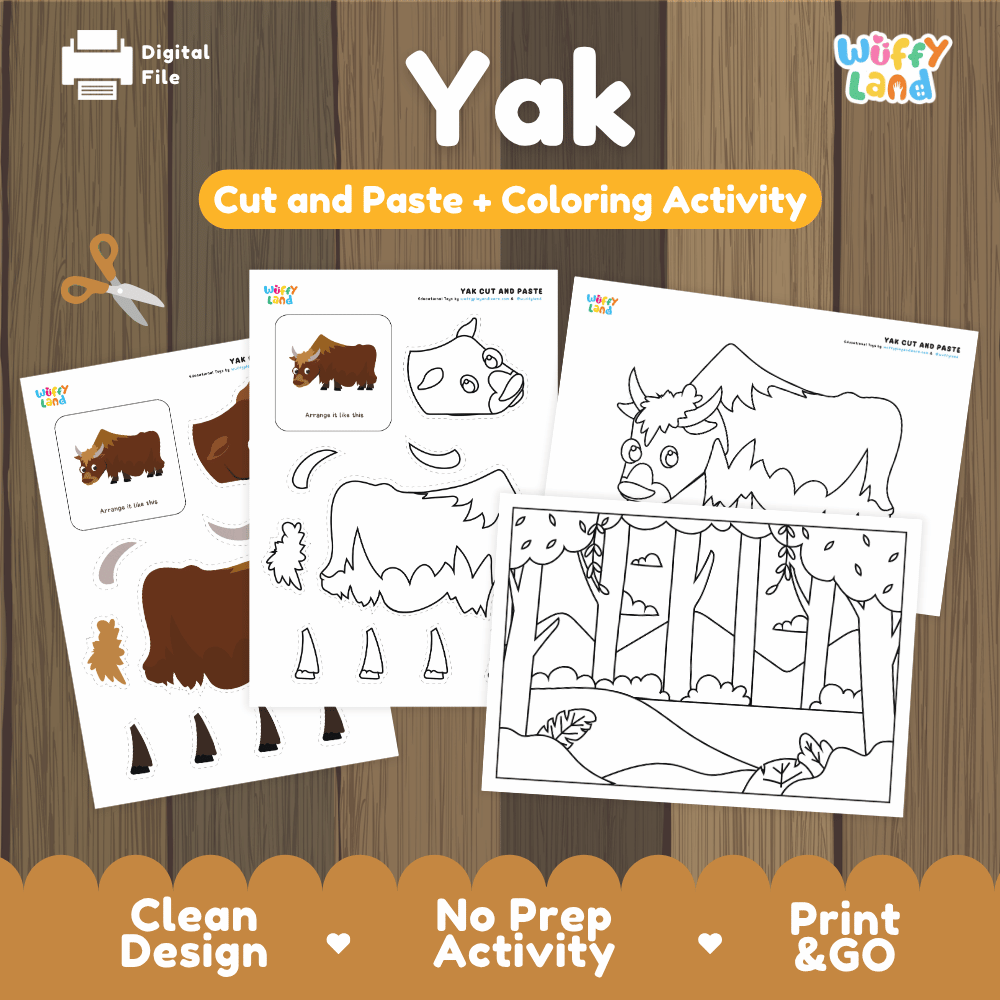
Yak Cut-and-Paste Craft & Coloring Worksheets →
Combine mountain animal learning with creative coloring, cutting, and pasting activities.
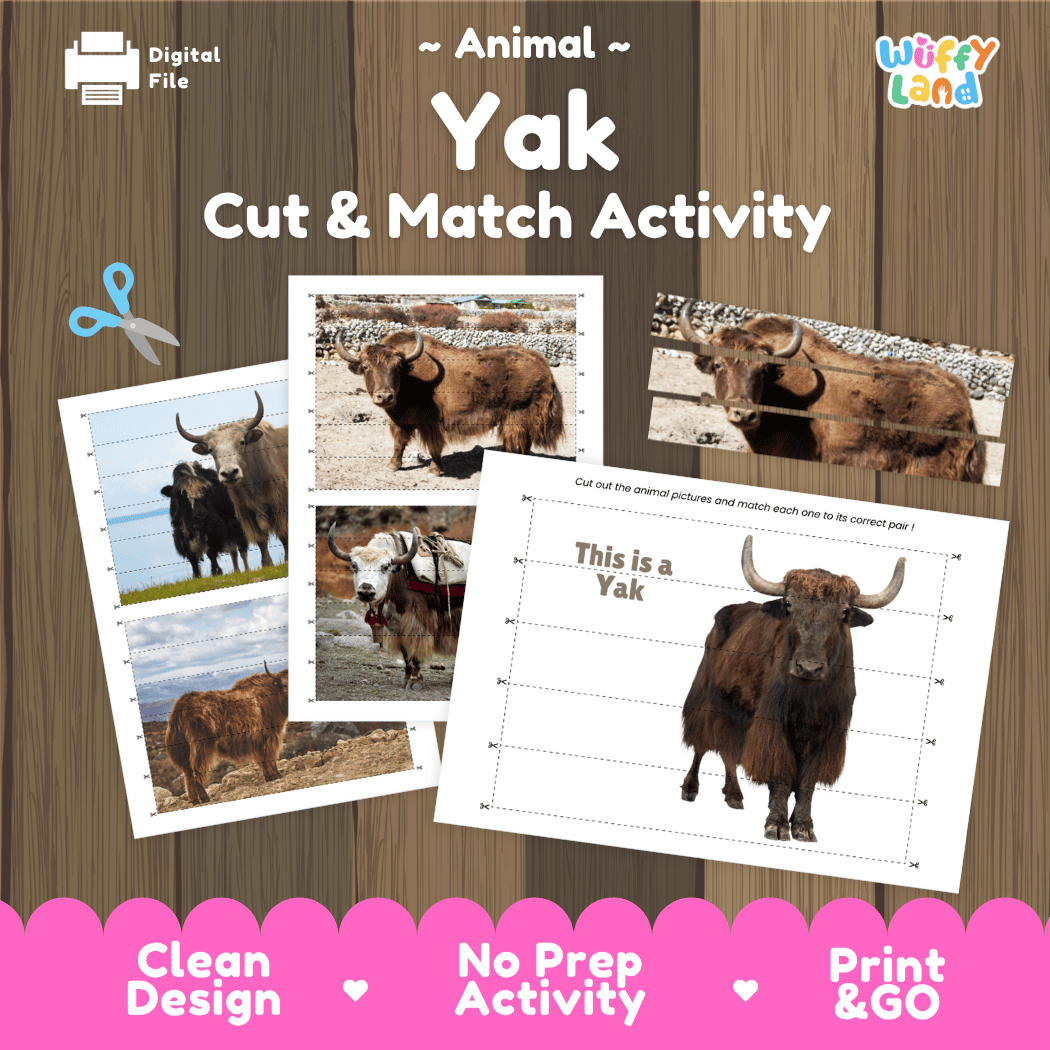
Yak Cut-and-Match Animal Puzzle Worksheets →
Develop visual matching, fine-motor skills, and problem-solving abilities with printable yak puzzles.