
Manatee for Kids | Facts, Habitat & Life Cycle
Imagine swimming through warm, shallow water and spotting a large, gentle animal slowly grazing on underwater plants. Meet the manatee, a fascinating aquatic mammal often called a sea cow because of its plant-eating habits and peaceful appearance.
In this Manatee Animal Guide for Kids, discover interesting manatee facts, where sea cows live, what they eat, how they breathe underwater, why they are related to elephants, and the stages of the manatee life cycle. Explore printable manatee research worksheets, Montessori life cycle cards, and reading comprehension activities for ocean and freshwater animal studies.
🌿 Manatee at a Glance
Manatees are large aquatic mammals belonging to the genus Trichechus and the order Sirenia. They are related to dugongs and are often called sea cows.
- Common Name: Manatee
- Scientific Genus: Trichechus
- Animal Group: Mammal
- Order: Sirenia
- Family: Trichechidae
- Species: West Indian Manatee, Amazonian Manatee, and African Manatee
- Habitat: Warm coastal waters, estuaries, rivers, and freshwater environments
- Distribution: Parts of the Americas and western Africa, depending on species
- Diet: Primarily Herbivorous
- Main Food: Seagrasses, freshwater vegetation, and other aquatic plants
- Baby Name: Calf
- Life Cycle: Developing Calf → Newborn Calf → Growing Calf → Juvenile → Adult
- Special Features: Paddle-shaped tail, flexible lips, whiskers, strong flippers, and continuously replacing cheek teeth
Students can record their discoveries using our Manatee Animal Research Worksheets for Early Elementary.
🌊 Where Do Manatees Live?
Manatees live in warm aquatic environments, including coastal waters, estuaries, rivers, and freshwater habitats.
There are three living species of manatees, each with a different geographic distribution.
- West Indian Manatee: Found in parts of the Caribbean, Gulf of Mexico, southeastern United States, and nearby coastal regions.
- Amazonian Manatee: Lives in freshwater rivers, lakes, and flooded forests of the Amazon Basin.
- African Manatee: Found in coastal and freshwater environments of western Africa.
Manatees generally prefer warm water because prolonged exposure to cold temperatures can be dangerous.
Some populations move seasonally to find suitable temperatures and abundant aquatic vegetation.
🌱 What Do Manatees Eat?
One of the most interesting manatee facts for kids is that manatees are primarily herbivores.
Unlike dolphins and most whales, which eat other animals, manatees feed mainly on aquatic vegetation.
Common foods include:
- Seagrasses: Underwater flowering plants that grow in shallow coastal environments.
- Freshwater Plants: Vegetation growing in rivers, lakes, and wetlands.
- Floating Plants: Aquatic plants found near the water's surface.
- Other Aquatic Vegetation: Different plant species depending on habitat and food availability.
Manatees use their flexible upper lips to grasp and pull plants into their mouths.
Their broad chewing teeth help grind tough plant material.
🐘 Are Manatees Related to Elephants?
Although manatees live in water and resemble some marine mammals, their evolutionary relatives include elephants.
Manatees and elephants belong to a larger group of mammals called Paenungulata, which also includes hyraxes.
They share distant common ancestors, even though their bodies have evolved for very different environments.
Elephants are adapted for life on land, while manatees have specialized bodies for swimming and feeding underwater.
This relationship is an interesting example of how evolution can produce very different animals from ancient shared ancestors.
🏊 How Do Manatees Swim?
Manatees have large, rounded bodies and broad, paddle-shaped tails.
They move their tails up and down to propel themselves through water.
Their front flippers help them steer, maneuver, and sometimes handle food.
Manatees usually swim slowly, although they can move faster for short periods.
Their gentle swimming style helps them travel through shallow waterways and areas filled with aquatic plants.
💨 How Do Manatees Breathe?
Manatees are mammals, not fish, so they breathe air using lungs.
They have two nostrils near the top of their snouts.
When a manatee surfaces, it opens its nostrils to breathe before diving again.
Manatees can hold their breath underwater for several minutes, and resting individuals may remain submerged longer than actively swimming animals.
Unlike fish, they cannot extract oxygen directly from water using gills.
🦷 Why Do Manatees Keep Growing New Teeth?
Manatees have an unusual dental adaptation.
Because they eat large amounts of aquatic vegetation, their chewing teeth gradually wear down.
New cheek teeth develop toward the back of the jaw and slowly move forward, replacing older teeth as they wear out and fall away.
This process is sometimes called marching molars.
It allows manatees to continue grinding tough plant material throughout their lives.
🐋 Manatee vs. Dugong
Manatees and dugongs are both members of the order Sirenia, but they have several important differences.
- Manatees: Have broad, rounded, paddle-shaped tails and can live in freshwater, brackish water, and coastal marine environments.
- Dugongs: Have whale-like, fluked tails and live primarily in coastal marine habitats where seagrasses grow.
Both animals are aquatic mammals that breathe air, give birth to live young, and feed mainly on plants.
👶 Manatee Life Cycle
The manatee life cycle begins before birth, when a developing calf grows inside its mother's body.
- Developing Calf: The unborn manatee grows inside its mother during pregnancy.
- Newborn Calf: A baby manatee is born in the water and begins breathing air at the surface.
- Growing Calf: The calf drinks its mother's milk and gradually begins eating aquatic plants.
- Juvenile Manatee: The young manatee becomes increasingly independent while continuing to grow.
- Adult Manatee: A mature manatee can reproduce and continue the life cycle.
Manatee pregnancy generally lasts about 12–13 months, although the timing varies among species.
Females usually give birth to one calf at a time.
Newborn calves depend on their mothers for milk, protection, and guidance.
Young manatees may remain closely associated with their mothers for one to two years while learning where to find food and suitable habitats.
Explore these stages with our Manatee Life Cycle Poster and Cut-and-Paste Worksheets or Manatee Life Cycle Montessori 3-Part Cards.
🔍 Parts of a Manatee
Manatees have specialized body structures that help them swim, feed, and survive in aquatic environments.
- Head: Contains the eyes, ears, nostrils, and mouth.
- Nostrils: Openings used for breathing air at the surface.
- Eyes: Help detect light and movement underwater.
- Flexible Upper Lip: Helps grasp and pull aquatic plants into the mouth.
- Whiskers: Sensitive hairs that help detect touch and explore the environment.
- Cheek Teeth: Grind plant material and are continually replaced throughout life.
- Front Flippers: Help with steering, movement, and handling food.
- Rounded Body: Supports aquatic movement and energy storage.
- Thick Skin: Provides a protective outer covering.
- Paddle-Shaped Tail: Provides propulsion during swimming.
💚 Why Are Manatees Important to Aquatic Ecosystems?
Manatees are important plant-eating mammals in aquatic ecosystems.
By grazing on seagrasses and other aquatic vegetation, they can influence plant growth and the structure of underwater habitats.
Their feeding activities also contribute to nutrient cycling within aquatic environments.
Healthy seagrass beds provide shelter and food for many fish, crustaceans, and other aquatic organisms.
Protecting manatees and their habitats helps support the broader ecosystems in which they live.
⚠️ What Threatens Manatees?
Manatees face several environmental threats, although the risks vary among species and locations.
- Boat Collisions: Watercraft can injure or kill manatees in busy waterways.
- Habitat Loss: Coastal development and changes to wetlands can reduce suitable habitat.
- Seagrass Decline: Poor water quality and habitat changes can reduce important food sources.
- Cold Stress: Exposure to unusually cold water can be dangerous for manatees.
- Fishing Gear: Entanglement can cause serious injuries.
Conservation efforts include habitat protection, safer boating practices, water quality improvements, and wildlife monitoring.
💡 Interesting Manatee Facts for Kids
- Manatees are aquatic mammals, not fish.
- They are often called sea cows.
- There are three living species of manatees.
- Manatees belong to the order Sirenia.
- They are distant evolutionary relatives of elephants.
- Manatees are primarily herbivores.
- They eat seagrasses and other aquatic plants.
- They have broad, paddle-shaped tails.
- Manatees breathe air using lungs.
- Their cheek teeth are continuously replaced throughout life.
- A baby manatee is called a calf.
- Manatee calves drink milk from their mothers.
✏️ Manatee Activities for Kids
Manatee activities are perfect for exploring aquatic mammals, marine ecosystems, freshwater habitats, herbivores, seagrass food webs, animal adaptations, conservation, and mammal life cycles.
Students can compare manatees with dugongs, investigate why manatees depend on aquatic plants, or practice nonfiction reading using our Manatee Reading Passage and Comprehension Worksheets.
For a more comprehensive lesson, the Manatee Life Cycle 3-in-1 Bundle combines complementary research and life cycle learning resources.
🌸 Explore Our Manatee Learning Resources
Discover five printable manatee educational resources from Wuffyland for elementary science lessons, aquatic mammal studies, Montessori-inspired learning, and homeschool activities.

Manatee Animal Research Worksheets for Early Elementary →
Explore manatee habitats, aquatic plant diets, physical features, and adaptations with printable animal research activities.
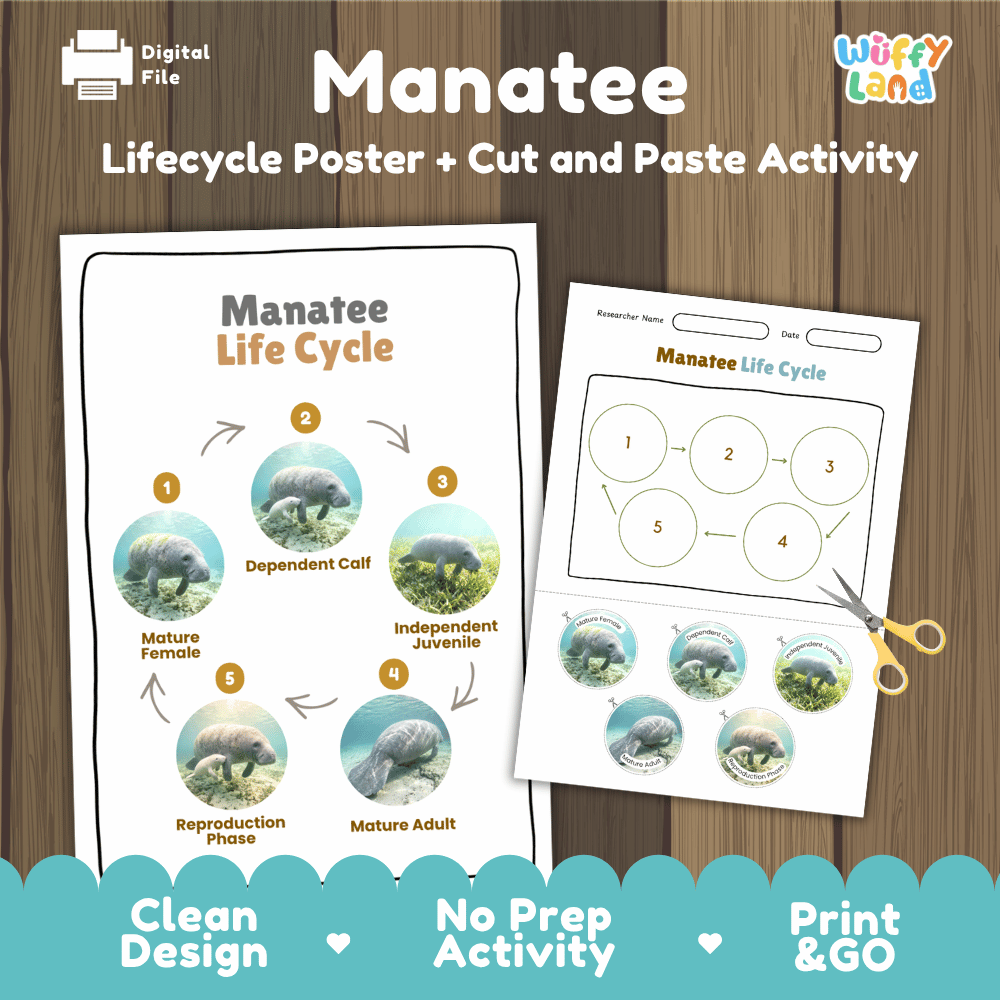
Manatee Life Cycle Poster & Cut-and-Paste Worksheets →
Explore manatee development from calf to adult with visual life cycle and sequencing activities.

Manatee Life Cycle Montessori 3-Part Cards →
Practice aquatic mammal life cycle vocabulary, matching, and sequencing with Montessori-inspired printable cards.
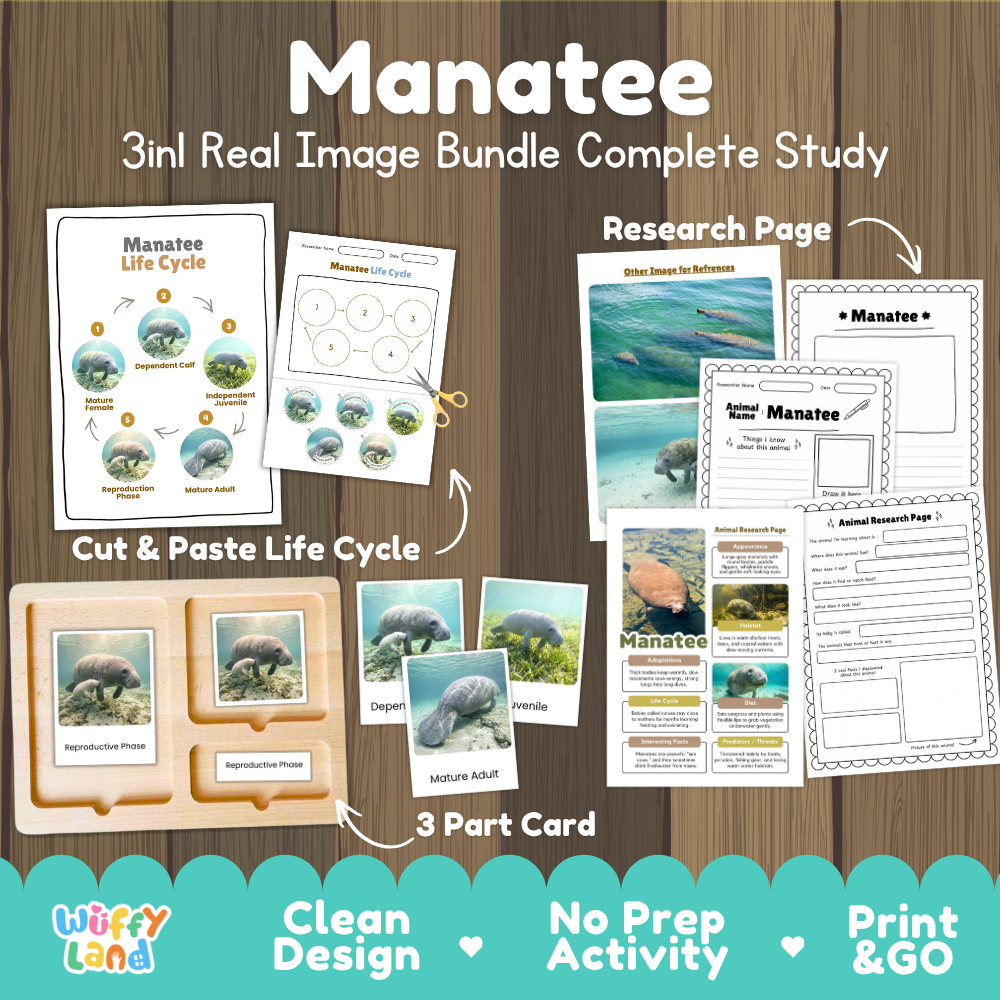
Manatee Life Cycle 3-in-1 Bundle →
Combine manatee research, real-image learning resources, and Montessori life cycle cards in one bundle.

Manatee Reading Passage & Comprehension Worksheets →
Build nonfiction reading skills with an informational passage, comprehension questions, and answer key.