
Humpback Whale for Kids | Facts, Songs & Life Cycle
Imagine watching an enormous whale leap almost completely out of the ocean before crashing back into the waves with a spectacular splash! Meet the humpback whale, one of the most fascinating marine mammals, famous for its beautiful underwater songs, long flippers, and incredible ocean journeys.
In this Humpback Whale Animal Guide for Kids, discover amazing humpback whale facts, where these ocean giants live, how they communicate, why they breach, how bubble-net feeding works, and the stages of the humpback whale life cycle. Explore printable humpback whale research worksheets, Montessori life cycle cards, reading comprehension activities, and creative ocean animal crafts.
🐋 Humpback Whale at a Glance
The humpback whale is a marine mammal belonging to the family Balaenopteridae, a group of baleen whales commonly called rorquals.
- Common Name: Humpback Whale
- Scientific Name: Megaptera novaeangliae
- Animal Group: Mammal
- Family: Balaenopteridae
- Habitat: Open oceans, coastal feeding grounds, and breeding waters
- Distribution: Major oceans around the world
- Diet: Carnivore
- Main Food: Krill and small schooling fish
- Baby Name: Calf
- Life Cycle: Developing Calf → Newborn Calf → Growing Calf → Juvenile → Adult
- Special Features: Long pectoral flippers, baleen plates, throat grooves, whale songs, and powerful tail flukes
Students can record their discoveries using our Humpback Whale Animal Research Worksheets and Fact Sheet.
🌊 Where Do Humpback Whales Live?
Humpback whales inhabit major oceans around the world, including the Atlantic, Pacific, Indian, and Southern Oceans.
Many humpback whale populations migrate between colder feeding areas and warmer breeding waters.
During feeding seasons, humpback whales often gather in productive ocean regions where krill and small fish are abundant.
During breeding seasons, many populations travel toward tropical or subtropical waters.
These long-distance migrations make humpback whales remarkable ocean travelers.
📏 How Big Is a Humpback Whale?
One of the most impressive humpback whale facts for kids is its enormous size.
Adult humpback whales commonly measure approximately 12–16 meters (39–52 feet) in length, although individual sizes vary.
Females are generally slightly larger than males.
Humpback whales have broad bodies and exceptionally long pectoral flippers.
Their flippers can measure approximately one-third of their total body length, making them proportionally longer than those of many other whale species.
🎵 Why Do Humpback Whales Sing?
Humpback whales are famous for producing complex sequences of underwater sounds known as whale songs.
Male humpback whales are especially known for singing long, structured songs, often during breeding seasons.
These songs may last for many minutes and can be repeated over extended periods.
Scientists believe whale songs play a role in reproductive behavior, although their exact functions are still being studied.
Humpback whale songs can also change over time, and groups of whales in the same region may share similar song patterns.
🫧 What Is Bubble-Net Feeding?
One of the most fascinating humpback whale behaviors is bubble-net feeding.
Some humpback whales use bubbles to help concentrate schools of fish or krill.
During this feeding behavior, whales release streams of bubbles underwater that can form a ring or spiral around their prey.
The bubbles may help keep prey grouped together.
Whales then swim upward with their mouths open, capturing concentrated prey.
Bubble-net feeding can involve cooperation among several whales, although not all humpback whale populations use this technique.
🐟 What Do Humpback Whales Eat?
Humpback whales are carnivores, meaning they eat other animals.
Their diets include:
- Krill: Tiny shrimp-like crustaceans that gather in large groups.
- Small Schooling Fish: Including species such as herring, anchovies, and sand lance, depending on location.
- Other Small Marine Animals: Occasionally included depending on available prey.
Humpback whales do not have teeth like dolphins or orcas.
Instead, they have hundreds of baleen plates that help filter food from seawater.
🌊 How Do Humpback Whales Feed Using Baleen?
Humpback whales use baleen plates made of keratin to filter food from water.
When feeding, a whale opens its mouth and takes in seawater along with krill or small fish.
Expandable throat grooves allow the mouth and throat region to expand.
The whale then pushes water out through its baleen while retaining the prey.
Humpback whales may use several feeding strategies, including lunge feeding and, in some populations, bubble-net feeding.
🌊 Why Do Humpback Whales Breach?
Breaching occurs when a whale launches much of its body out of the water before splashing back into the ocean.
Humpback whales are especially well known for this dramatic behavior.
Scientists have suggested several possible reasons for breaching, including communication, social interactions, and the removal of external parasites.
The exact reasons can vary depending on the situation and are not completely understood.
Humpback whales also perform other surface behaviors, including tail slapping and flipper slapping.
💨 How Do Humpback Whales Breathe?
Humpback whales are mammals, not fish, so they breathe air using lungs.
They have two blowholes on top of their heads.
When a humpback whale reaches the surface, it exhales air and water vapor, producing a visible blow.
Humpback whales can hold their breath during dives, but they must return to the surface regularly.
Unlike fish, they cannot extract oxygen directly from seawater using gills.
🐋 Humpback Whale vs. Blue Whale
Humpback whales and blue whales are both baleen whales, but they have different characteristics.
- Humpback Whales: Known for long pectoral flippers, complex songs, dramatic breaching, and varied feeding strategies.
- Blue Whales: The largest animals known to have ever lived, with streamlined bodies and diets consisting mainly of krill.
Both species breathe air, give birth to live young, and feed their calves with milk.
👶 Humpback Whale Life Cycle
The humpback whale life cycle begins before birth, when a developing calf grows inside its mother's body.
- Developing Calf: The unborn whale grows inside its mother during pregnancy.
- Newborn Calf: A baby humpback whale is born in the water and begins breathing air at the surface.
- Growing Calf: The calf drinks its mother's rich milk and grows rapidly.
- Juvenile Whale: The young whale becomes more independent and continues developing toward adulthood.
- Adult Whale: A mature humpback whale can reproduce and continue the life cycle.
Humpback whale pregnancy lasts approximately 11–12 months.
Females usually give birth to one calf at a time.
A newborn humpback whale calf may measure approximately 4–5 meters (13–16 feet) long.
Young calves depend on their mothers for milk, protection, and guidance during their early development.
Explore these stages with our Humpback Whale Life Cycle Poster and Cut-and-Paste Worksheets or Humpback Whale Life Cycle Montessori 3-Part Cards.
🔍 Parts of a Humpback Whale
Humpback whales have specialized body structures that help them swim, feed, and survive in ocean environments.
- Head: Contains the eyes, mouth, and blowholes.
- Blowholes: Two openings used for breathing air.
- Eyes: Help detect light and movement underwater.
- Mouth: Expands to take in seawater and prey during feeding.
- Baleen Plates: Filter krill and small fish from seawater.
- Throat Grooves: Expand during feeding.
- Pectoral Flippers: Exceptionally long flippers that help with steering and maneuvering.
- Dorsal Fin: A relatively small fin on the back.
- Blubber: A thick layer of fat that provides insulation and energy storage.
- Tail Flukes: Powerful horizontal structures that propel the whale through water.
💡 Interesting Humpback Whale Facts for Kids
- Humpback whales are marine mammals, not fish.
- Their scientific name is Megaptera novaeangliae.
- They live in major oceans around the world.
- Many humpback whales migrate long distances each year.
- They have exceptionally long pectoral flippers.
- Male humpback whales produce complex underwater songs.
- Some humpback whales use bubble-net feeding.
- They eat krill and small schooling fish.
- Humpback whales use baleen plates instead of teeth.
- They are famous for breaching above the ocean surface.
- They breathe air through two blowholes.
- A baby humpback whale is called a calf and drinks milk from its mother.
✏️ Humpback Whale Activities for Kids
Humpback whale activities are perfect for exploring marine mammals, ocean ecosystems, whale songs, animal communication, bubble-net feeding, migration, baleen whales, and mammal life cycles.
Students can compare humpback whales with blue whales, investigate how bubble-net feeding works, or practice nonfiction reading using our Humpback Whale Reading Passage and Comprehension Worksheets.
For creative learning, children can enjoy our Humpback Whale Cut-and-Paste Craft and Coloring Worksheets, combining marine mammal science with art and fine-motor practice.
For a more comprehensive lesson, the Humpback Whale Life Cycle 3-in-1 Bundle combines complementary research and life cycle learning resources.
🌸 Explore Our Humpback Whale Learning Resources
Discover six printable humpback whale educational resources from Wuffyland for elementary science lessons, ocean animal studies, Montessori-inspired learning, and homeschool activities.
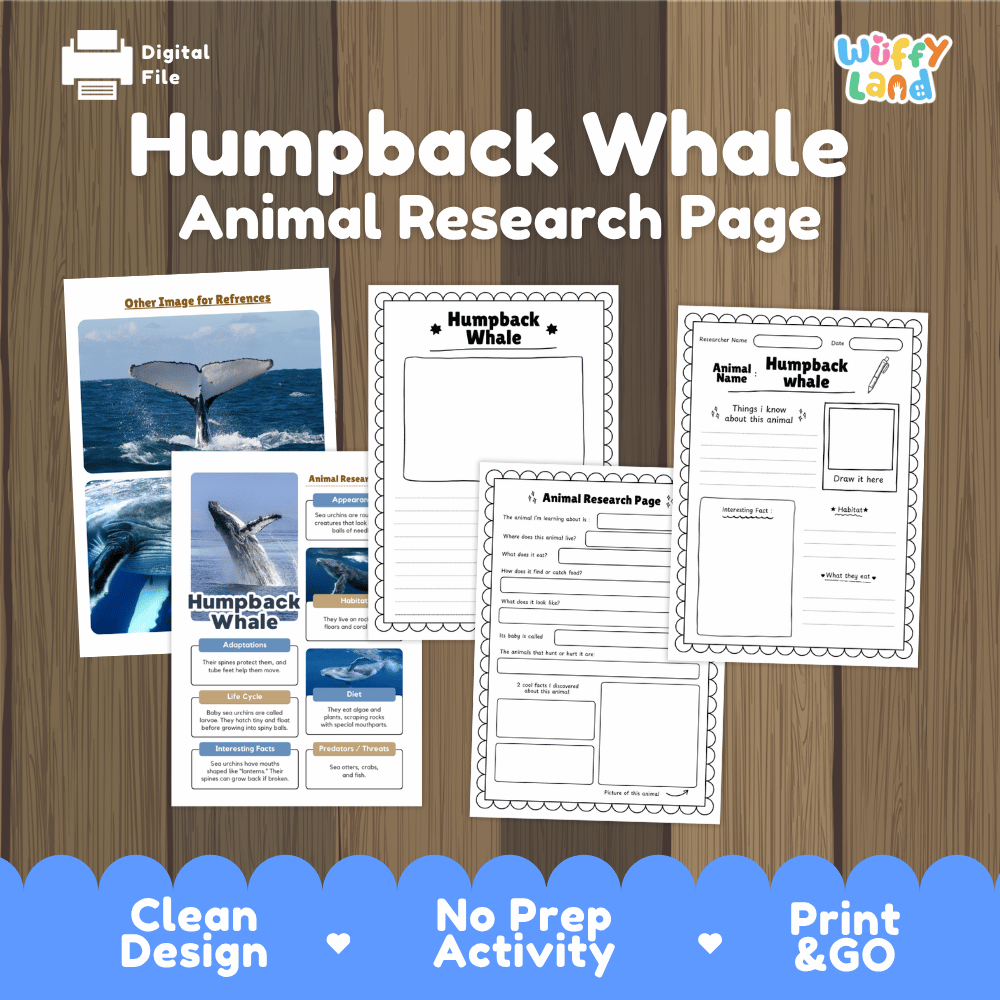
Humpback Whale Animal Research Worksheets & Fact Sheet →
Explore humpback whale habitats, diet, physical features, and adaptations with printable animal research activities.
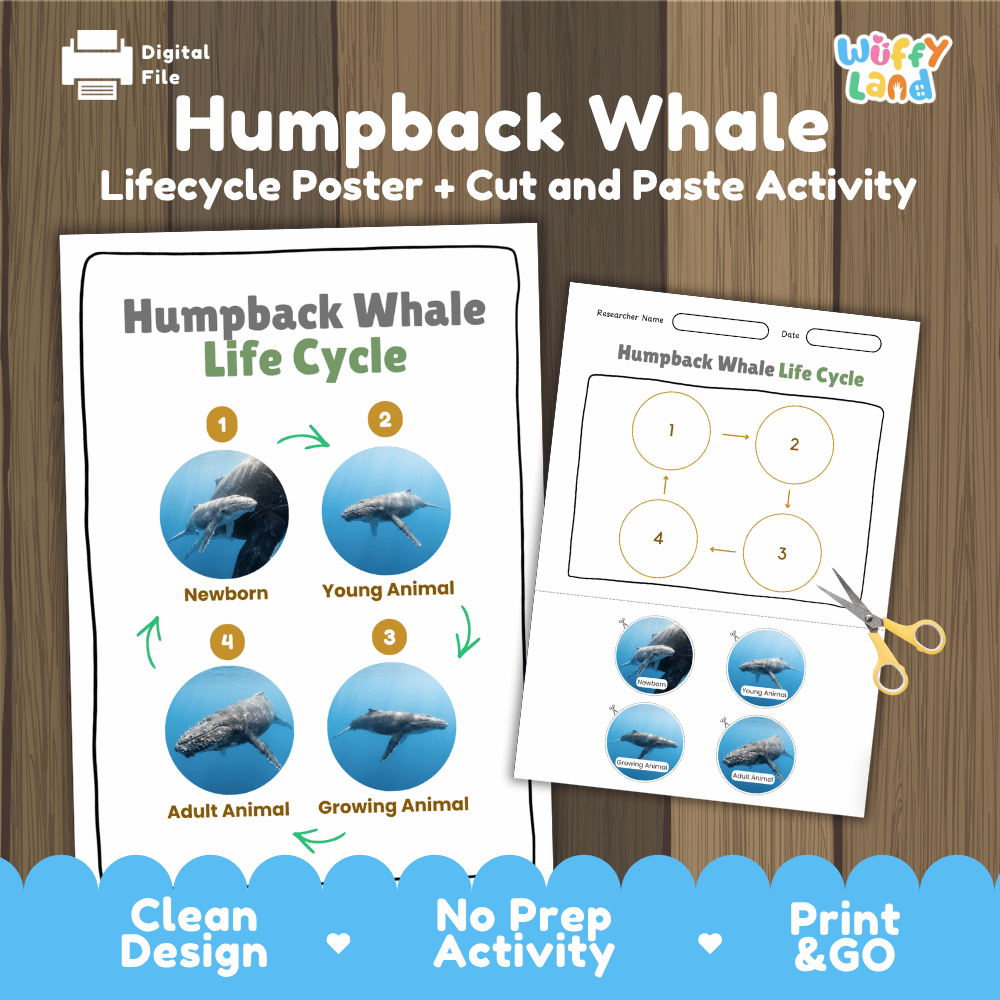
Humpback Whale Life Cycle Poster & Cut-and-Paste Worksheets →
Explore humpback whale development from calf to adult with visual life cycle and sequencing activities.
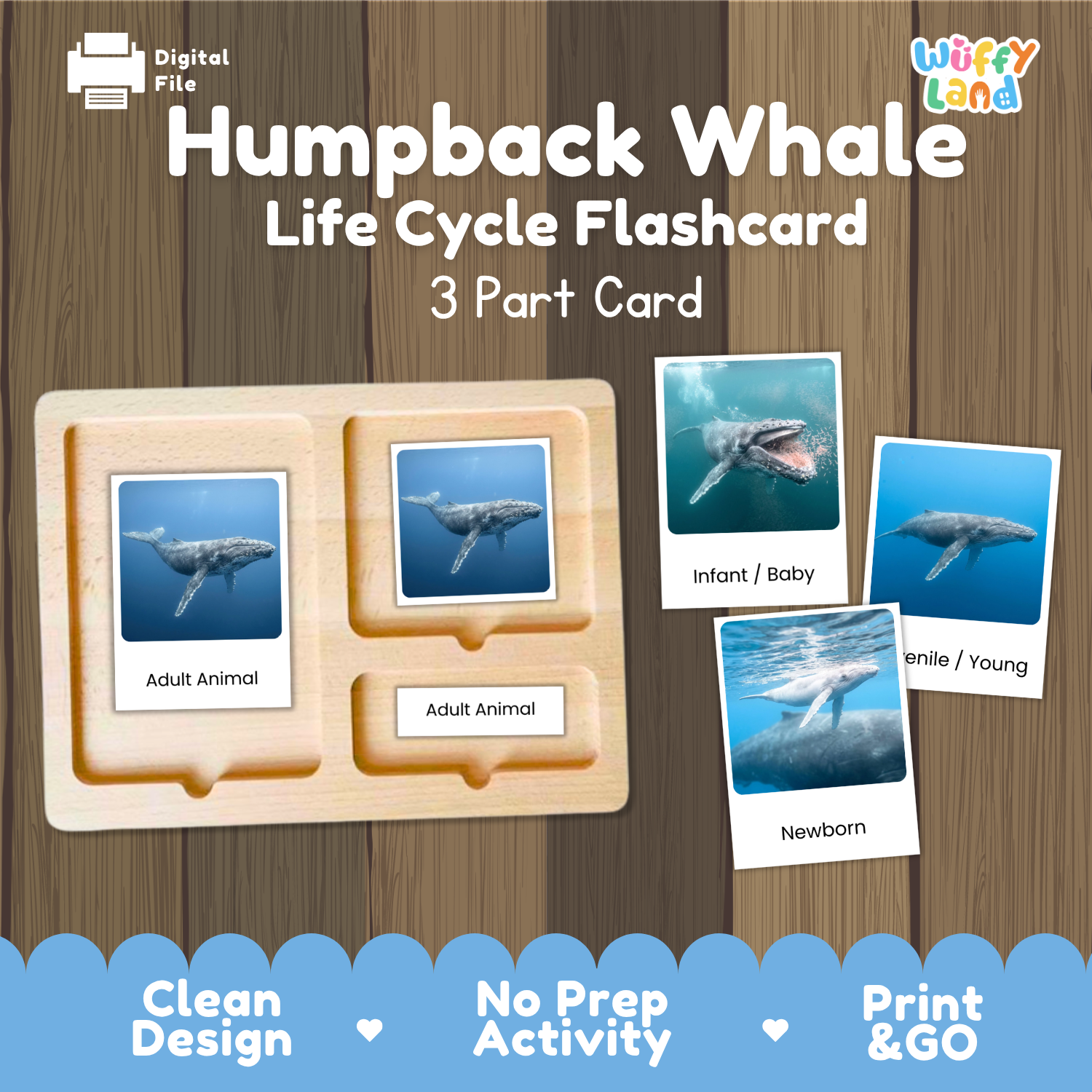
Humpback Whale Life Cycle Montessori 3-Part Cards →
Practice marine mammal life cycle vocabulary, matching, and sequencing with Montessori-inspired printable cards.
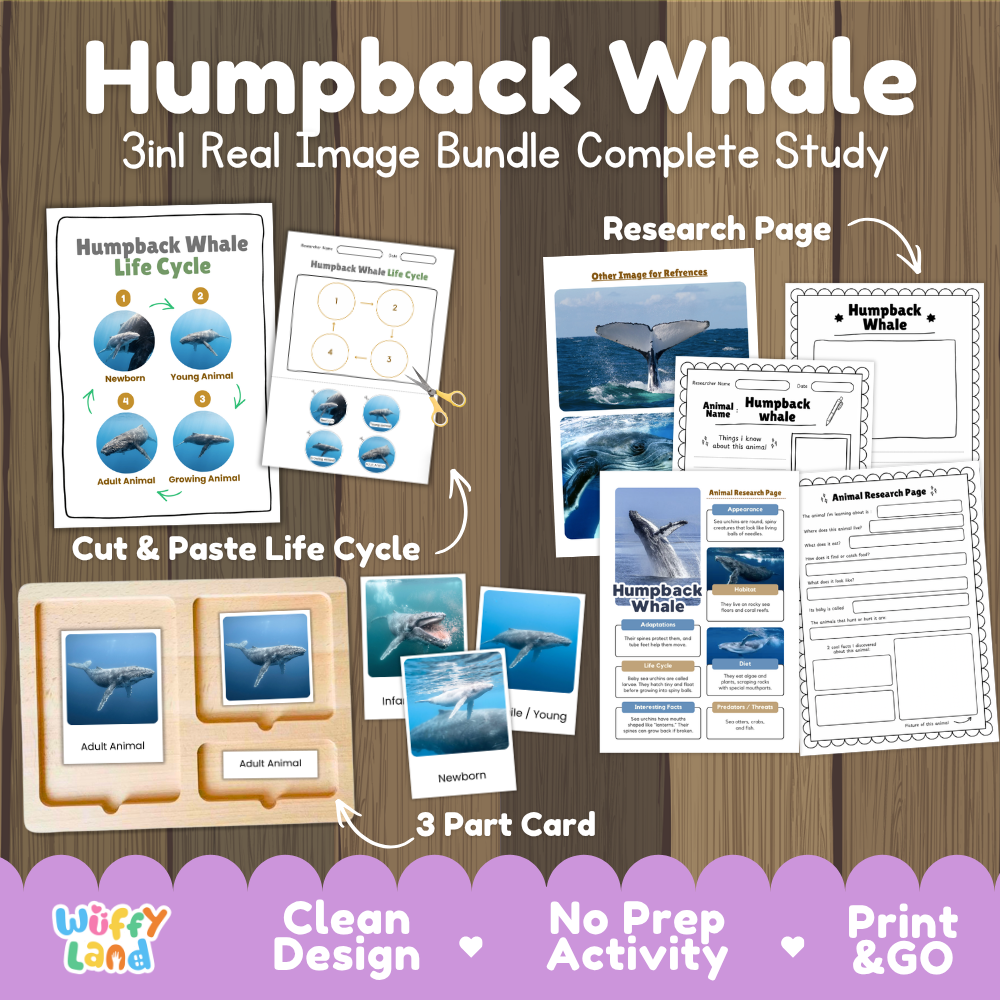
Humpback Whale Life Cycle 3-in-1 Bundle →
Combine humpback whale research, real-image learning resources, and Montessori life cycle cards in one bundle.
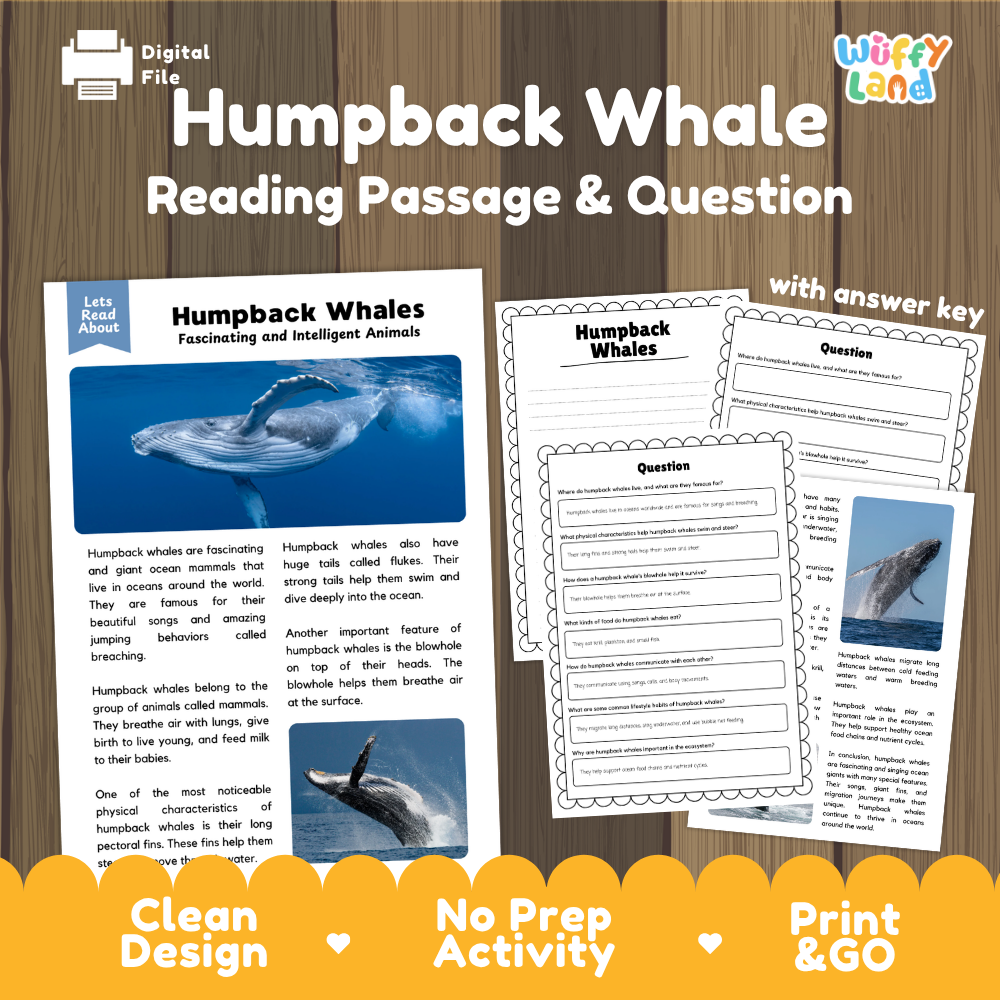
Humpback Whale Reading Passage & Comprehension Worksheets →
Build nonfiction reading skills with an informational passage, comprehension questions, and answer key.
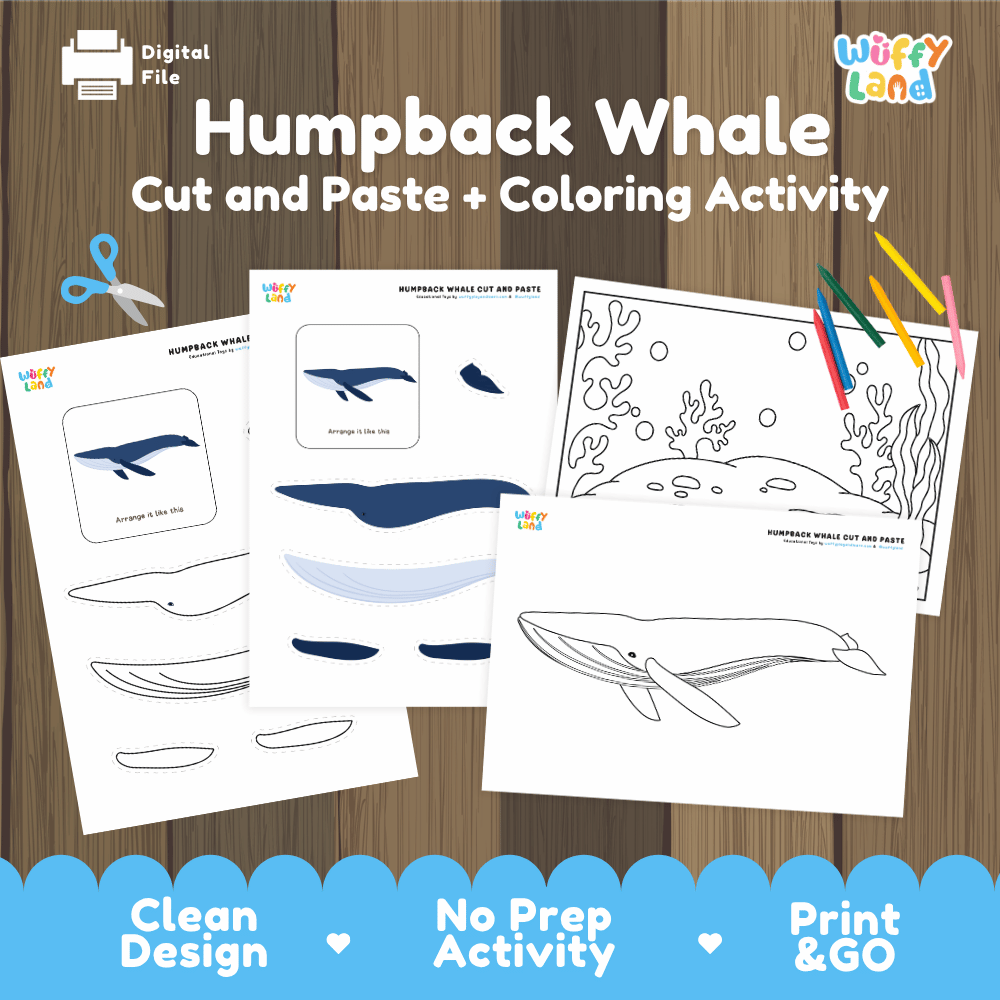
Humpback Whale Cut-and-Paste Craft & Coloring Worksheets →
Combine marine mammal learning with creative coloring, cutting, and pasting activities.