
Fin Whale for Kids | Facts, Habitat & Life Cycle
Imagine an enormous whale gliding through the open ocean with a long, streamlined body and a tall spout of mist rising above the waves! Meet the fin whale, one of the largest animals on Earth and an incredible example of marine mammal adaptations.
In this Fin Whale Animal Guide for Kids, discover fascinating fin whale facts, where these ocean giants live, how they filter food using baleen, why their jaws have different colors, and the stages of the fin whale life cycle. Explore printable fin whale research worksheets, Montessori life cycle cards, reading comprehension activities, and creative whale crafts.
🐋 Fin Whale at a Glance
The fin whale is a marine mammal belonging to the family Balaenopteridae, a group of baleen whales commonly called rorquals.
- Common Name: Fin Whale
- Scientific Name: Balaenoptera physalus
- Animal Group: Mammal
- Family: Balaenopteridae
- Habitat: Open oceans, productive feeding waters, and some coastal marine environments
- Distribution: Major oceans around the world
- Diet: Carnivore
- Main Food: Krill, small schooling fish, and other small marine animals
- Baby Name: Calf
- Life Cycle: Developing Calf → Newborn Calf → Growing Calf → Juvenile → Adult
- Special Features: Streamlined body, asymmetrical jaw coloration, baleen plates, expandable throat grooves, and powerful tail flukes
Students can record their discoveries using our Fin Whale Animal Research Worksheets and Fact Sheet.
🌊 Where Do Fin Whales Live?
Fin whales inhabit major oceans around the world, including the Atlantic, Pacific, Indian, and Southern Oceans.
They occur in both temperate and polar waters, and some populations also travel through warmer marine environments.
Many fin whales move seasonally between feeding areas and breeding regions.
They often feed in productive waters where krill and small schooling fish are abundant.
Migration patterns vary among populations, and some fin whales remain in particular regions throughout much of the year.
📏 How Big Is a Fin Whale?
One of the most amazing fin whale facts for kids is its enormous size.
The fin whale is generally considered the second-largest living animal, after the blue whale.
Large adults can reach approximately 24–27 meters (79–89 feet) in length, although size varies among individuals and populations.
Fin whales have long, slender bodies that help them move efficiently through ocean water.
Their streamlined shape has earned them the nickname "greyhounds of the sea."
Despite their enormous bodies, fin whales are powerful swimmers capable of traveling long distances.
🎨 Why Does a Fin Whale Have Different Jaw Colors?
One of the most distinctive features of fin whales is their asymmetrical coloration.
The right side of the lower jaw is typically pale or white, while the left side is darker.
This unusual pattern also extends to parts of the baleen inside the mouth.
Scientists have investigated whether this coloration is related to feeding behavior, although its exact function remains uncertain.
This feature helps researchers identify fin whales and distinguish them from some other baleen whale species.
🦐 What Do Fin Whales Eat?
Fin whales are carnivores, meaning they eat other animals.
They feed on small marine organisms, including:
- Krill: Tiny shrimp-like crustaceans that form large groups in the ocean.
- Small Schooling Fish: Fish that gather together in large groups.
- Other Small Crustaceans: Included in the diet depending on location and food availability.
Fin whales do not have teeth like dolphins or orcas.
Instead, they use hundreds of baleen plates to filter food from seawater.
These plates are made of keratin, the same protein found in human hair and fingernails.
🌊 How Do Fin Whales Feed Using Baleen?
Fin whales use a feeding method called lunge feeding.
During a feeding lunge, the whale accelerates toward a dense group of prey and opens its mouth widely.
Expandable throat grooves allow the mouth and throat region to expand and hold a large volume of water and food.
The whale then pushes seawater out through its baleen plates while retaining krill and small fish.
This feeding method allows fin whales to capture large amounts of food in a relatively short time.
💨 How Do Fin Whales Breathe?
Fin whales are mammals, not fish, so they breathe air using lungs.
They have two blowholes on top of their heads.
When a fin whale reaches the surface, it exhales air and water vapor, producing a tall, visible blow.
Fin whales can hold their breath during dives, but they must return to the surface to breathe.
Unlike fish, they cannot extract oxygen directly from seawater using gills.
🎵 How Do Fin Whales Communicate?
Fin whales produce powerful, low-frequency sounds that can travel long distances through seawater.
These sounds may help whales communicate across large areas of the ocean.
Scientists study fin whale vocalizations to learn about their distribution, movements, and behavior.
Some fin whale calls occur in repeating patterns, which researchers can detect using underwater recording equipment.
Human-generated underwater noise may interfere with whale communication and is an important concern in marine conservation.
🐋 Fin Whale vs. Blue Whale
Fin whales and blue whales are both enormous baleen whales, but they have several differences.
- Fin Whales: Generally smaller and more slender than blue whales, with distinctive asymmetrical jaw coloration.
- Blue Whales: The largest animals known to have ever lived, with broad bodies and diets consisting mainly of krill.
Both species use baleen to filter food, breathe air through blowholes, and nurse their calves with milk.
👶 Fin Whale Life Cycle
The fin whale life cycle begins before birth, when a developing calf grows inside its mother's body.
- Developing Calf: The unborn whale grows inside its mother during pregnancy.
- Newborn Calf: A baby fin whale is born in the water and begins breathing air at the surface.
- Growing Calf: The calf drinks its mother's rich milk and grows rapidly.
- Juvenile Whale: The young whale becomes independent and continues developing toward adulthood.
- Adult Whale: A mature fin whale can reproduce and continue the life cycle.
Fin whale pregnancy lasts approximately 11–12 months.
Females usually give birth to one calf at a time.
A newborn fin whale calf may measure approximately 6 meters (20 feet) long.
Young calves depend on their mothers for milk and protection during their early months.
Explore these stages with our Fin Whale Life Cycle Poster and Cut-and-Paste Worksheets or Fin Whale Life Cycle Montessori 3-Part Cards.
🔍 Parts of a Fin Whale
Fin whales have specialized body structures that help them swim, feed, and survive in ocean environments.
- Head: Contains the eyes, mouth, and blowholes.
- Blowholes: Two openings used for breathing air.
- Eyes: Help detect light and movement underwater.
- Mouth: Expands to take in seawater and prey during feeding.
- Baleen Plates: Filter krill and small fish from seawater.
- Throat Grooves: Expand during lunge feeding.
- Pectoral Flippers: Help steer and stabilize the whale.
- Dorsal Fin: A curved fin located toward the rear of the back.
- Blubber: A thick layer of fat that provides insulation and energy storage.
- Tail Flukes: Powerful horizontal structures that propel the whale through water.
💡 Interesting Fin Whale Facts for Kids
- Fin whales are the second-largest living animals after blue whales.
- Their scientific name is Balaenoptera physalus.
- They are marine mammals, not fish.
- Fin whales live in major oceans around the world.
- They have distinctive asymmetrical jaw coloration.
- The right side of the lower jaw is usually pale or white.
- Fin whales use baleen plates instead of teeth.
- They eat krill, small fish, and other tiny marine animals.
- They use lunge feeding to capture large amounts of prey.
- Fin whales breathe air through two blowholes.
- They produce powerful low-frequency sounds.
- A baby fin whale is called a calf and drinks milk from its mother.
✏️ Fin Whale Activities for Kids
Fin whale activities are perfect for exploring marine mammals, ocean ecosystems, baleen whales, animal adaptations, food chains, whale migration, and mammal life cycles.
Students can compare fin whales with blue whales, investigate how baleen filters food, or practice nonfiction reading using our Fin Whale Reading Passage and Comprehension Worksheets.
For creative learning, children can enjoy our Fin Whale Cut-and-Paste Craft and Coloring Worksheets, combining marine mammal science with art and fine-motor practice.
For a more comprehensive lesson, the Fin Whale Life Cycle 3-in-1 Bundle combines complementary research and life cycle learning resources.
🌸 Explore Our Fin Whale Learning Resources
Discover six printable fin whale educational resources from Wuffyland for elementary science lessons, ocean animal studies, Montessori-inspired learning, and homeschool activities.

Fin Whale Animal Research Worksheets & Fact Sheet →
Explore fin whale habitats, diet, physical features, and adaptations with printable animal research activities.

Fin Whale Life Cycle Poster & Cut-and-Paste Worksheets →
Explore fin whale development from calf to adult with visual life cycle and sequencing activities.

Fin Whale Life Cycle Montessori 3-Part Cards →
Practice marine mammal life cycle vocabulary, matching, and sequencing with Montessori-inspired printable cards.

Fin Whale Life Cycle 3-in-1 Bundle →
Combine fin whale research, real-image learning resources, and Montessori life cycle cards in one bundle.
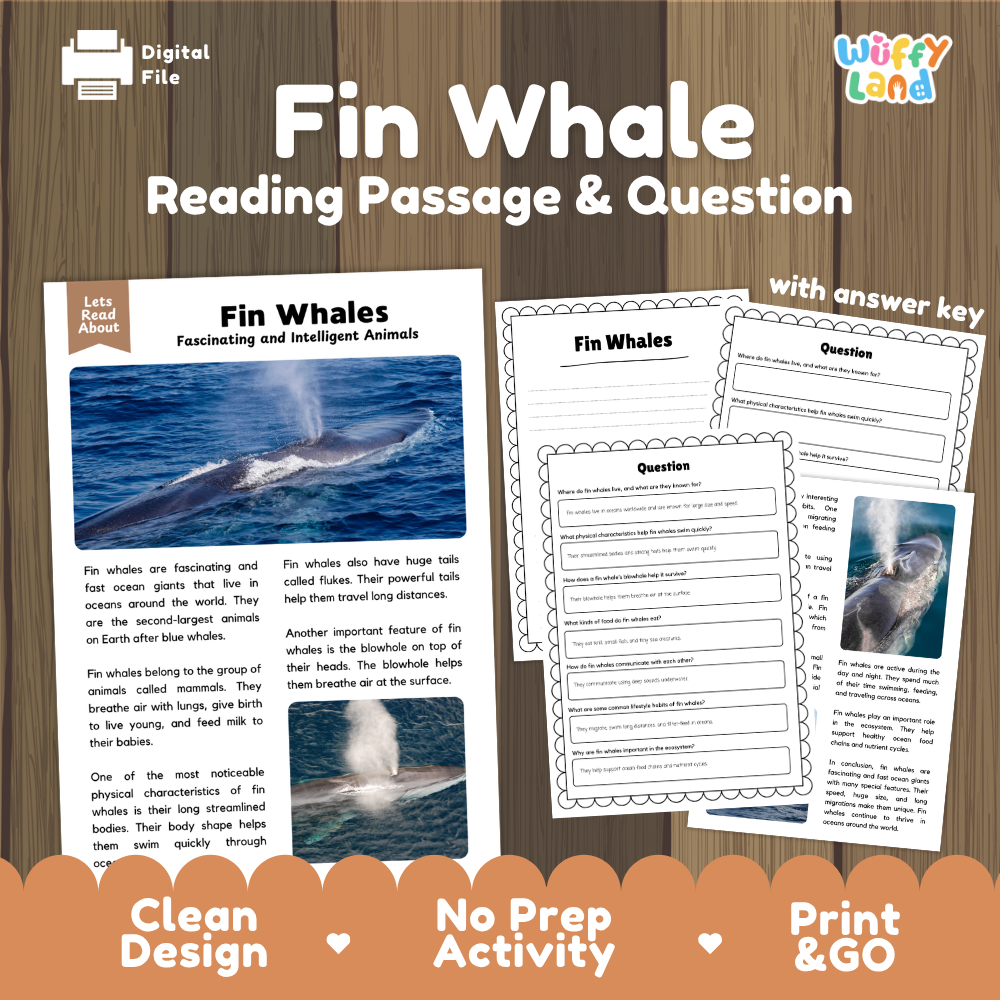
Fin Whale Reading Passage & Comprehension Worksheets →
Build nonfiction reading skills with an informational passage, comprehension questions, and answer key.

Fin Whale Cut-and-Paste Craft & Coloring Worksheets →
Combine marine mammal learning with creative coloring, cutting, and pasting activities.