
Elephant Seal for Kids | Facts, Diving & Life Cycle
Imagine a giant seal resting on a beach with a nose that looks like a short elephant trunk! Meet the elephant seal, one of the most remarkable marine mammals in the world. These enormous seals are famous for their incredible diving abilities, powerful bodies, and unusual appearance.
In this Elephant Seal Animal Guide for Kids, discover fascinating elephant seal facts, where they live, how deep they dive, what they eat, why adult males have large noses, and the stages of the elephant seal life cycle. Explore printable elephant seal research worksheets, Montessori life cycle cards, and reading comprehension activities.
🦭 Elephant Seal at a Glance
Elephant seals are large marine mammals belonging to the genus Mirounga. They are true seals in the family Phocidae.
- Common Name: Elephant Seal
- Scientific Genus: Mirounga
- Animal Group: Mammal
- Family: Phocidae
- Species: Northern Elephant Seal and Southern Elephant Seal
- Habitat: Open oceans, coastal beaches, and breeding colonies
- Distribution: North Pacific and Southern Ocean regions, depending on species
- Diet: Carnivore
- Main Food: Fish, squid, and other marine animals
- Baby Name: Pup
- Life Cycle: Newborn Pup → Nursing Pup → Weaned Juvenile → Adult
- Special Features: Large body size, deep-diving ability, thick blubber, powerful flippers, and enlarged noses in adult males
Students can record their discoveries using our Elephant Seal Animal Research Worksheets.
🌊 Where Do Elephant Seals Live?
Elephant seals spend much of their lives swimming and diving in the ocean.
There are two living species of elephant seals.
- Northern Elephant Seal: Found mainly in the North Pacific Ocean, with breeding colonies along parts of the Pacific coast of North America.
- Southern Elephant Seal: Found across the Southern Ocean and nearby regions, with breeding colonies on subantarctic islands and some mainland coasts.
Both species come ashore to breed, give birth, nurse their pups, and molt.
For much of the year, however, elephant seals travel through open ocean environments in search of food.
🐘 Why Are They Called Elephant Seals?
One of the most interesting elephant seal facts for kids is the unusual nose of adult males.
Male elephant seals develop an enlarged, inflatable nose called a proboscis.
This nose resembles a short elephant trunk, which gives elephant seals their common name.
The proboscis helps adult males produce loud vocalizations during the breeding season.
These calls can help males communicate their presence and compete with rivals.
Female elephant seals do not develop the same enormous nose.
📏 How Big Are Elephant Seals?
Elephant seals are among the largest seals in the world.
The southern elephant seal is the largest living seal species.
Large adult southern elephant seal males can reach approximately 5–6 meters (16–20 feet) in length and weigh several metric tons.
Females are much smaller than males, a difference known as sexual dimorphism.
Northern elephant seals are also enormous, although they are generally smaller than southern elephant seals.
Their large bodies and thick blubber help them survive long periods in cold ocean environments.
🌊 How Deep Can Elephant Seals Dive?
Elephant seals are extraordinary deep-diving mammals.
They regularly dive hundreds of meters below the ocean surface while searching for food.
Some recorded dives have exceeded 1,500 meters (4,900 feet), and exceptional dives can be even deeper.
Elephant seals have adaptations that help them manage oxygen during long dives.
They store substantial amounts of oxygen in their blood and muscles, and their bodies can reduce oxygen use in certain tissues while underwater.
These abilities allow them to spend long periods searching for prey in deep ocean environments.
🐟 What Do Elephant Seals Eat?
Elephant seals are carnivores, meaning they eat other animals.
Their diets vary depending on species, location, and available prey.
Common foods include:
- Fish: Including deep-water fish and other marine species.
- Squid: Important prey for many elephant seals.
- Other Marine Animals: Occasionally included depending on feeding habitat.
Elephant seals often search for food far below the ocean surface.
They use their sensitive whiskers and other sensory abilities to help detect prey in underwater environments.
🏖️ Why Do Elephant Seals Gather on Beaches?
Elephant seals gather on land during important stages of their annual life cycle.
During the breeding season, large groups form colonies on beaches.
Adult males compete for access to breeding females, sometimes using loud calls, body displays, and physical contests.
Females give birth to pups and nurse them on land.
Elephant seals also return to land for their annual molt, when they shed and replace their outer layer of fur and skin.
These gatherings provide opportunities for scientists to study elephant seal reproduction and behavior.
🦭 Elephant Seal vs. Sea Lion
Elephant seals and sea lions are both pinnipeds, but they belong to different families.
- Elephant Seals: True seals with no visible external ear flaps. They move awkwardly on land but are excellent deep divers.
- Sea Lions: Eared seals with visible external ear flaps and hind flippers that can rotate forward, allowing them to move more easily on land.
Both groups are marine mammals that breathe air, give birth to live young, and nurse their pups with milk.
👶 Elephant Seal Life Cycle
The elephant seal life cycle begins before birth, when a developing pup grows inside its mother's body.
- Developing Pup: The unborn seal grows inside its mother during pregnancy.
- Newborn Pup: A baby elephant seal is born on land at a breeding colony.
- Nursing Pup: The pup drinks its mother's extremely rich milk and grows rapidly.
- Weaned Juvenile: The young seal becomes independent and gradually learns to forage at sea.
- Adult Seal: A mature elephant seal can reproduce and continue the life cycle.
Female elephant seals usually give birth to one pup at a time.
Elephant seal milk is extremely rich in fat, allowing pups to gain weight quickly during a relatively short nursing period.
Northern elephant seal pups are typically nursed for about four weeks, while nursing duration in southern elephant seals is often somewhat shorter.
After weaning, pups remain on land for a period before entering the ocean and beginning to develop their diving and feeding abilities.
Explore these stages with our Elephant Seal Life Cycle Poster and Cut-and-Paste Worksheets or Elephant Seal Life Cycle Montessori 3-Part Cards.
🔍 Parts of an Elephant Seal
Elephant seals have specialized body structures that help them dive, swim, and survive in marine environments.
- Head: Contains the eyes, nose, mouth, and sensory structures.
- Proboscis: An enlarged nose found in adult males.
- Eyes: Help detect light and movement underwater.
- Whiskers: Sensitive hairs that help detect movement in water.
- Teeth: Help grasp prey.
- Front Flippers: Help with steering and movement.
- Hind Flippers: Provide propulsion during swimming.
- Blubber: A thick layer of fat that provides insulation and energy storage.
- Fur: Provides a protective outer covering.
- Streamlined Body: Helps reduce drag while swimming.
💡 Interesting Elephant Seal Facts for Kids
- Elephant seals are marine mammals, not fish.
- There are two living species: northern and southern elephant seals.
- They belong to the genus Mirounga.
- Southern elephant seals are the largest living seals.
- Adult males have enlarged noses called proboscises.
- Elephant seals can dive to extraordinary ocean depths.
- They eat fish, squid, and other marine animals.
- They spend much of their lives at sea.
- They return to land to breed and molt.
- Female elephant seals usually give birth to one pup.
- Elephant seal pups drink rich milk from their mothers.
- Elephant seals are members of the pinniped group.
✏️ Elephant Seal Activities for Kids
Elephant seal activities are perfect for exploring marine mammals, pinnipeds, ocean ecosystems, deep-diving adaptations, animal classification, and mammal life cycles.
Students can compare elephant seals with sea lions, investigate how deep-diving mammals conserve oxygen, or practice nonfiction reading using our Elephant Seal Reading Passage and Comprehension Worksheets.
For a more comprehensive lesson, the Elephant Seal Life Cycle 3-in-1 Bundle combines complementary research and life cycle learning resources.
🌸 Explore Our Elephant Seal Learning Resources
Discover five printable elephant seal educational resources from Wuffyland for elementary science lessons, marine mammal studies, Montessori-inspired learning, and homeschool activities.

Elephant Seal Animal Research Worksheets →
Explore elephant seal habitats, diet, body size, and diving adaptations with printable animal research activities.

Elephant Seal Life Cycle Poster & Cut-and-Paste Worksheets →
Explore elephant seal development from pup to adult with visual life cycle and sequencing activities.

Elephant Seal Life Cycle Montessori 3-Part Cards →
Practice pinniped life cycle vocabulary, matching, and sequencing with Montessori-inspired printable cards.

Elephant Seal Life Cycle 3-in-1 Bundle →
Combine elephant seal research, real-image learning resources, and Montessori life cycle cards in one bundle.
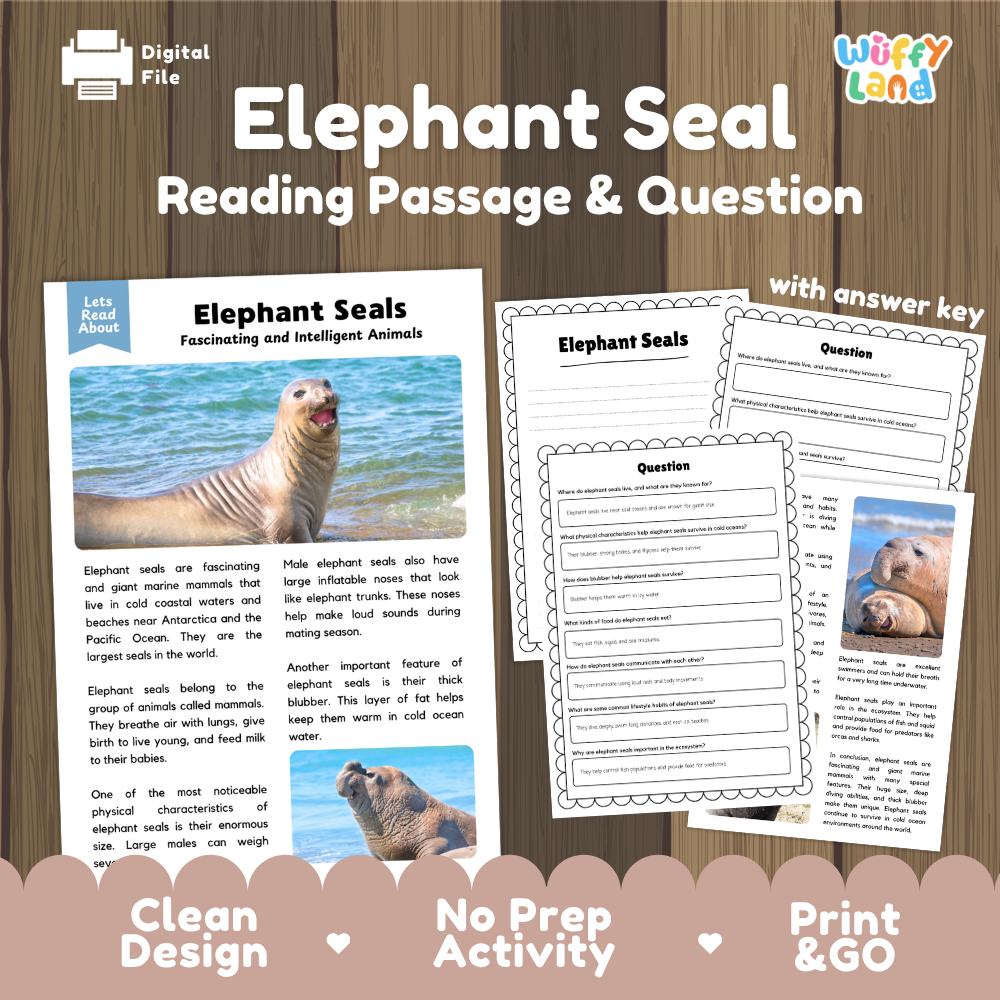
Elephant Seal Reading Passage & Comprehension Worksheets →
Build nonfiction reading skills with an informational passage, comprehension questions, and answer key.