
Crab Facts for Kids | Habitat, Molting & Life Cycle
Claws, jointed legs, and a protective outer covering make crabs exciting animals to investigate! Explore crab facts for kids while connecting animal science with research, reading, sequencing, and creative learning.
Crabs include many species with different habitats and diets. This guide introduces general features and a developmental pattern common to many marine crabs. Choose a named species when researching specific details.
🔎 Crabs at a Glance
- Animal group: Crustaceans.
- Larger group: Arthropods.
- Outer covering: An exoskeleton.
- Limbs: Five pairs, with the front pair forming claws in typical true crabs.
- Growth process: Molting.
- Common marine larval stages: Zoea followed by megalopa.
Begin with the Crab Animal Research Project. Organize discoveries under headings such as appearance, habitat, food, and development.
🌊 Where Do Crabs Live?
Crabs occupy many environments. Marine examples live on rocky shores, sandy or muddy bottoms, and coral reefs. Other species use freshwater or terrestrial habitats.
Habitat investigation: Choose one crab species and research where it lives. Record its name beside your notes.
Comparison activity: Compare photographs of a rocky shore and a mangrove forest. Discuss the different shelters and surfaces available to animals.
🦀 How Many Legs Does a Crab Have?
Crabs are decapod crustaceans. “Decapod” means ten-footed, referring to five pairs of limbs. In a typical true crab, the front pair carries the claws.
Counting activity: Use a clear top-view photograph to identify the paired limbs. Count the claws as part of the total rather than adding them afterward.
Observation question: Are all the limbs shaped the same way?
🦪 What Do Crabs Eat?
Diet differs among species. Some crabs eat other animals and decaying material, while others feed heavily on plants, algae, or particles collected from sediment.
For example, red-fingered marsh crabs eat mainly mangrove leaves and other plant material.
Research activity: Choose one species and identify two foods it eats. Explain why its diet should not automatically be applied to every crab.
Connect the topic with the Crab Reading Passage and Comprehension Worksheets for informational reading practice.
🔄 Why Do Crabs Molt?
A crab’s hard outer covering is called an exoskeleton. To increase in size, the crab sheds its old covering and expands before the new one hardens.
This process is called molting.
Sequence activity: Draw three labeled pictures: old covering, shedding, and new covering.
Thinking prompt: Why might a crab need shelter while its new covering is soft?
🥚 Crab Life Cycle for Kids
Many marine crabs pass through distinctive larval stages before developing the familiar crab shape.
A simplified sequence is:
- Egg: An embryo develops inside an egg.
- Zoea: A small larva swims and drifts in the water, growing through molts.
- Megalopa: A later stage develops more crab-like features before becoming a juvenile.
- Juvenile: The young crab has the familiar crab form and continues growing.
- Adult: A mature crab can reproduce, beginning the cycle again.
This sequence represents a common marine pattern, not every crab species. The number of larval stages and their timing vary.
Practice sequencing with the Crab Life Cycle Poster and Cut-and-Paste Worksheets.
Revisit vocabulary with the Crab Life Cycle Flashcards and Montessori 3-Part Cards. Retell the sequence using first, next, then, and finally.
🔍 Do Baby Crabs Look Like Adults?
Not always. In species such as blue crabs, newly hatched zoeae look very different from adults. Their body form changes substantially during development.
Compare and observe: Study labeled images of a zoea, megalopa, and juvenile from the same species.
Writing starter: “One change I notice as the crab develops is…”
🐾 Observe a Crab’s Body Parts
Use a clearly identified photograph to locate the carapace, eyes, claws, jointed legs, and abdomen. An underside view can reveal features hidden from above.
Draw and label: Sketch the crab from one viewpoint, then explain which features are difficult to see.
Research connection: Compare body-part shapes in two named species and investigate how they are used.
🎨 Connect Science with Creative Learning
Invite children to observe a wildlife photograph before beginning an art activity. Ask them to distinguish observed details from artistic choices.
Pair the Crab Cut-and-Paste Craft and Coloring Activity with an original fact caption.
Caption starter: “A crab grows by…”
💬 Crab Vocabulary to Explore
- Crustacean: An arthropod belonging to the group that includes crabs, shrimp, and barnacles.
- Exoskeleton: A supportive outer covering.
- Carapace: The main protective covering over the front body region.
- Molting: Shedding an outer covering during growth.
- Zoea: An early larval form of many crabs.
- Megalopa: A later developmental stage before the juvenile form in many crabs.
- Juvenile: A young animal that has not reached adulthood.
Vocabulary challenge: Use three words to explain part of a crab’s life.
📚 Crab Learning Activities
Build a lesson around the question: How does a crab’s body change as it grows? Invite children to explain ideas through research, reading, sequencing, matching, and art.
- Research: Gather facts about one crab species and write a short report.
- Observe: Identify paired limbs and compare their shapes.
- Sequence: Arrange the life stages of a chosen marine crab.
- Read: Connect animal science with informational reading and comprehension.
- Create: Add a factual caption to a craft or coloring activity.
- Match: Use the Crab Cut-and-Match Worksheets for visual observation practice.
- Extend: Explore the Crab Life Cycle 3-in-1 Bundle when planning a broader study.
Exit question: Explain the difference between molting and moving into a different habitat.
🌸 Explore Our Crab Learning Resources
Explore these seven printable resources for animal research, life cycle lessons, reading, crafts, and matching activities.
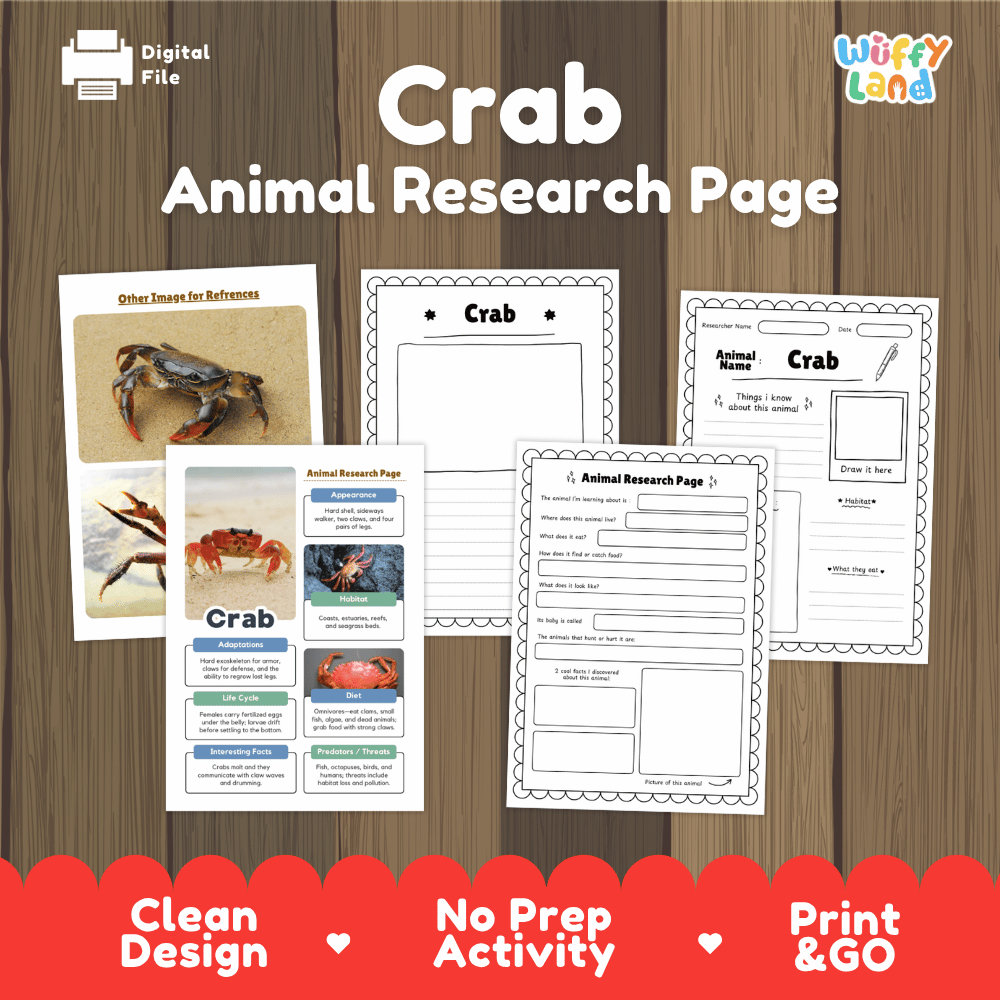
Crab Animal Research Project & Fact Sheet →
Organize discoveries and support informational writing about crabs.

Crab Life Cycle Poster & Cut-and-Paste Worksheets →
Introduce life cycle vocabulary and practice sequencing development.

Crab Life Cycle Flashcards & Montessori 3-Part Cards →
Revisit life cycle terms through naming, matching, and discussion.
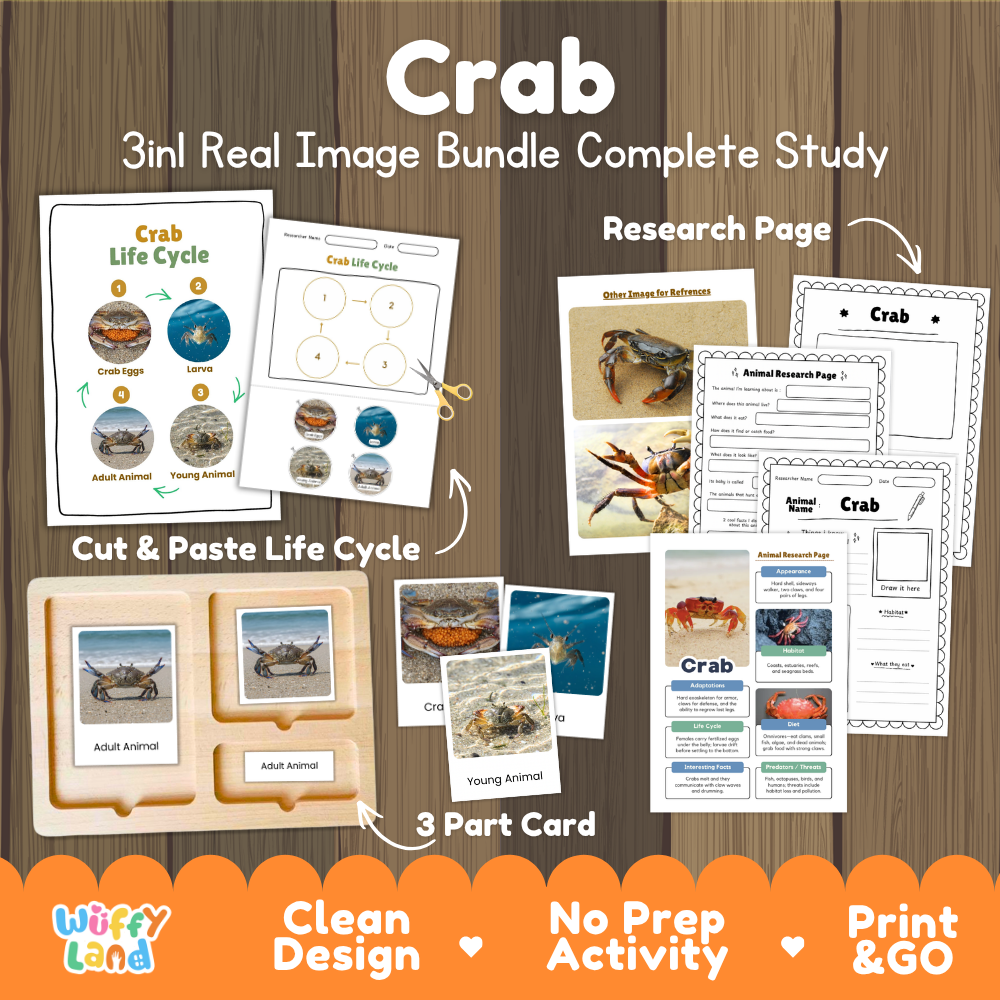
Crab Life Cycle 3-in-1 Bundle →
Explore a bundle option when planning connected crab lessons.

Crab Reading Passage & Comprehension Worksheets →
Connect animal science with informational reading and comprehension practice.

Crab Cut-and-Paste Craft & Coloring Activity →
Add cutting, pasting, and coloring to a crab learning session.

Crab Cut-and-Match Activity Worksheets →
Encourage careful observation with an ocean animal matching activity.