
Bottlenose Dolphin for Kids | Facts & Life Cycle
Imagine swimming through the ocean and hearing a series of clicks, whistles, and squeaks! A curious bottlenose dolphin may be nearby. Known for their intelligence, playful behavior, and remarkable communication skills, bottlenose dolphins are among the most fascinating marine mammals.
In this Bottlenose Dolphin Animal Guide for Kids, discover interesting dolphin facts, how dolphins use echolocation, what they eat, how they communicate, and the stages of the bottlenose dolphin life cycle. Explore printable dolphin research worksheets, Montessori life cycle cards, reading comprehension activities, and creative ocean animal crafts.
🐬 Bottlenose Dolphin at a Glance
Bottlenose dolphins are marine mammals belonging to the genus Tursiops. The common bottlenose dolphin, Tursiops truncatus, is one of the best-known dolphin species.
- Common Name: Bottlenose Dolphin
- Scientific Name: Tursiops truncatus (Common Bottlenose Dolphin)
- Animal Group: Mammal
- Family: Delphinidae
- Habitat: Coastal waters, bays, estuaries, and offshore marine environments
- Distribution: Temperate and tropical oceans around the world
- Diet: Carnivore
- Main Food: Fish, squid, and other marine animals
- Baby Name: Calf
- Adult Female: Cow
- Adult Male: Bull
- Life Cycle: Newborn Calf → Growing Calf → Juvenile → Adult
- Special Features: Echolocation, streamlined body, dorsal fin, flippers, blowhole, and social communication
Students can record their discoveries using our Bottlenose Dolphin Animal Research Project Worksheets and Fact Sheet.
🌊 Where Do Bottlenose Dolphins Live?
Bottlenose dolphins live in warm and temperate ocean waters around the world.
They can be found in coastal environments, bays, estuaries, and offshore waters.
Some populations remain near coastlines, while others live farther out at sea.
These different environments influence their feeding habits, movement patterns, and social behavior.
Although bottlenose dolphins are strong swimmers, they must regularly return to the surface to breathe air.
🔊 What Is Dolphin Echolocation?
One of the most amazing bottlenose dolphin facts for kids is their ability to use echolocation.
Echolocation is a way of detecting objects by producing sounds and listening to the returning echoes.
Bottlenose dolphins produce rapid clicking sounds that travel through water.
When the sound waves encounter an object, some of the sound reflects back toward the dolphin.
By interpreting these echoes, dolphins can gather information about the location, distance, and characteristics of objects around them.
Echolocation helps dolphins navigate underwater and locate prey, including in murky water or low-light conditions.
🧠 How Intelligent Are Bottlenose Dolphins?
Bottlenose dolphins are known for their complex learning abilities and social behavior.
Scientists have observed dolphins learning new behaviors, solving problems, recognizing individuals, and cooperating with other dolphins.
Some populations have developed specialized hunting techniques that younger dolphins may learn from experienced group members.
For example, certain dolphins in Shark Bay, Australia, use marine sponges as tools while searching for food on the seafloor.
These behaviors make bottlenose dolphins fascinating animals for studying learning, communication, and animal behavior.
🐟 What Do Bottlenose Dolphins Eat?
Bottlenose dolphins are carnivores, meaning they eat other animals.
Their diets vary depending on habitat and available prey.
Common foods include:
- Fish: Many species of schooling and bottom-dwelling fish.
- Squid: Soft-bodied marine animals with arms and tentacles.
- Other Marine Animals: Occasionally included depending on location and prey availability.
Bottlenose dolphins have numerous cone-shaped teeth that help them grasp slippery prey.
They usually swallow fish whole or in large pieces rather than chewing their food.
🤝 How Do Bottlenose Dolphins Communicate?
Bottlenose dolphins use a variety of sounds and body movements to communicate.
Their vocalizations include whistles, clicks, and burst-pulse sounds.
Many dolphins develop distinctive whistles called signature whistles, which can help identify individuals.
Dolphins also communicate through physical contact, body posture, and coordinated movements.
These communication abilities help them maintain social relationships and coordinate activities.
🐬 Do Bottlenose Dolphins Live in Groups?
Bottlenose dolphins are social animals that often live in groups called pods.
Group size and membership can change over time.
Some dolphins form long-lasting social bonds, while others move between different groups.
Dolphins may cooperate while feeding, travel together, or help protect vulnerable group members.
Their flexible social systems are an important part of bottlenose dolphin behavior.
💨 How Do Bottlenose Dolphins Breathe?
Bottlenose dolphins are mammals, not fish, so they breathe air using lungs.
They have a single blowhole located on top of the head.
When a dolphin surfaces, it opens its blowhole to exhale and inhale before diving again.
Dolphins can hold their breath underwater, but they must return to the surface regularly.
Unlike fish, dolphins cannot extract oxygen directly from water using gills.
🐋 Bottlenose Dolphin vs. Blue Whale
Bottlenose dolphins and blue whales are both marine mammals, but they have very different feeding adaptations.
- Bottlenose Dolphins: Smaller, toothed whales that use echolocation and hunt fish, squid, and other marine animals.
- Blue Whales: Enormous baleen whales that filter tiny krill from seawater using baleen plates.
Both breathe air, give birth to live young, and feed their calves milk.
👶 Bottlenose Dolphin Life Cycle
The bottlenose dolphin life cycle begins before birth, when a developing calf grows inside its mother's body.
- Developing Calf: The unborn dolphin grows inside its mother during pregnancy.
- Newborn Calf: A baby dolphin is born in the water and begins breathing air at the surface.
- Growing Calf: The calf drinks its mother's milk and gradually learns to swim, communicate, and find food.
- Juvenile Dolphin: The young dolphin becomes more independent while continuing to develop important survival skills.
- Adult Dolphin: A mature dolphin can reproduce and continue the life cycle.
Bottlenose dolphin pregnancy typically lasts approximately 12 months.
Females usually give birth to one calf at a time.
Newborn calves depend on their mothers for milk, protection, and guidance.
Young dolphins may remain closely associated with their mothers for several years while learning important behaviors.
Explore these stages with our Bottlenose Dolphin Life Cycle Poster and Cut-and-Paste Worksheets or Bottlenose Dolphin Life Cycle Montessori 3-Part Cards.
🔍 Parts of a Bottlenose Dolphin
Bottlenose dolphins have specialized body structures that help them swim, breathe, and find food.
- Head: Contains the brain, eyes, mouth, and structures involved in echolocation.
- Blowhole: A single opening on top of the head used for breathing.
- Melon: A fatty structure in the forehead that helps focus echolocation sounds.
- Rostrum: The elongated snout commonly called the beak.
- Teeth: Cone-shaped structures used to grasp prey.
- Eyes: Help detect light and movement.
- Dorsal Fin: Helps stabilize the dolphin while swimming.
- Pectoral Flippers: Help with steering and maneuvering.
- Blubber: A layer of fat that provides insulation and energy storage.
- Tail Flukes: Powerful horizontal structures that propel the dolphin through water.
💡 Interesting Bottlenose Dolphin Facts for Kids
- Bottlenose dolphins are marine mammals, not fish.
- The common bottlenose dolphin's scientific name is Tursiops truncatus.
- They live in temperate and tropical oceans around the world.
- Bottlenose dolphins breathe air through a single blowhole.
- They use echolocation to detect objects underwater.
- They produce whistles, clicks, and other sounds.
- Many dolphins have distinctive signature whistles.
- They are carnivores that eat fish and squid.
- Bottlenose dolphins often live in social groups called pods.
- A baby dolphin is called a calf.
- Dolphin calves drink milk from their mothers.
- Some bottlenose dolphins use tools while searching for food.
✏️ Bottlenose Dolphin Activities for Kids
Bottlenose dolphin activities are perfect for exploring marine mammals, ocean ecosystems, echolocation, animal intelligence, communication, food chains, and mammal life cycles.
Students can compare dolphins with blue whales, investigate how echolocation works, or practice nonfiction reading using our Bottlenose Dolphin Reading Passage and Comprehension Worksheets.
For creative learning, children can enjoy our Bottlenose Dolphin Cut-and-Paste Craft and Coloring Worksheets, combining marine mammal science with art and fine-motor practice.
For a more comprehensive lesson, the Bottlenose Dolphin Life Cycle 3-in-1 Bundle combines complementary research and life cycle learning resources.
🌸 Explore Our Bottlenose Dolphin Learning Resources
Discover six printable bottlenose dolphin educational resources from Wuffyland for elementary science lessons, ocean animal studies, Montessori-inspired learning, and homeschool activities.

Bottlenose Dolphin Animal Research Worksheets & Fact Sheet →
Explore dolphin habitats, diet, physical features, and adaptations with printable animal research activities.

Bottlenose Dolphin Life Cycle Poster & Cut-and-Paste Worksheets →
Explore dolphin development from calf to adult with visual life cycle and sequencing activities.

Bottlenose Dolphin Life Cycle Montessori 3-Part Cards →
Practice marine mammal life cycle vocabulary, matching, and sequencing with Montessori-inspired printable cards.

Bottlenose Dolphin Life Cycle 3-in-1 Bundle →
Combine dolphin research, real-image learning resources, and Montessori life cycle cards in one bundle.
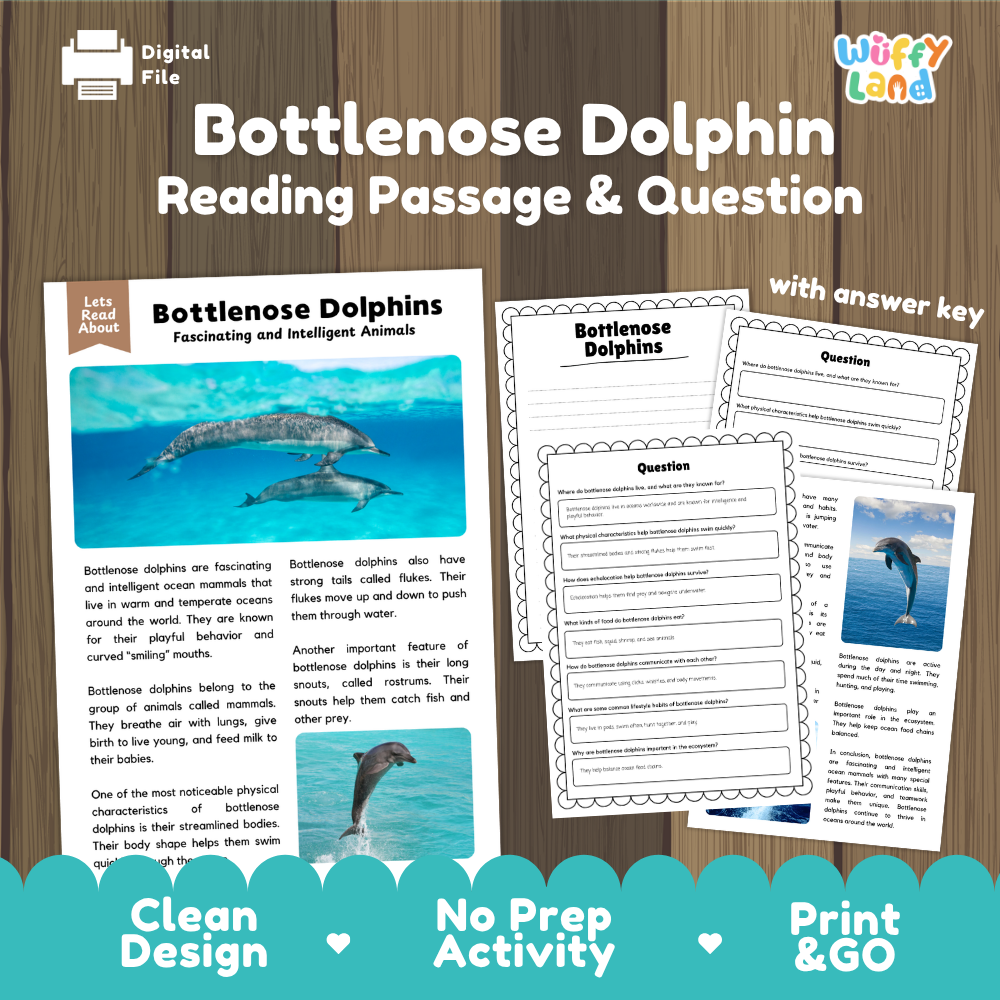
Bottlenose Dolphin Reading Passage & Comprehension Worksheets →
Build nonfiction reading skills with an informational passage, comprehension questions, and answer key.

Bottlenose Dolphin Cut-and-Paste Craft & Coloring Worksheets →
Combine marine mammal learning with creative coloring, cutting, and pasting activities.